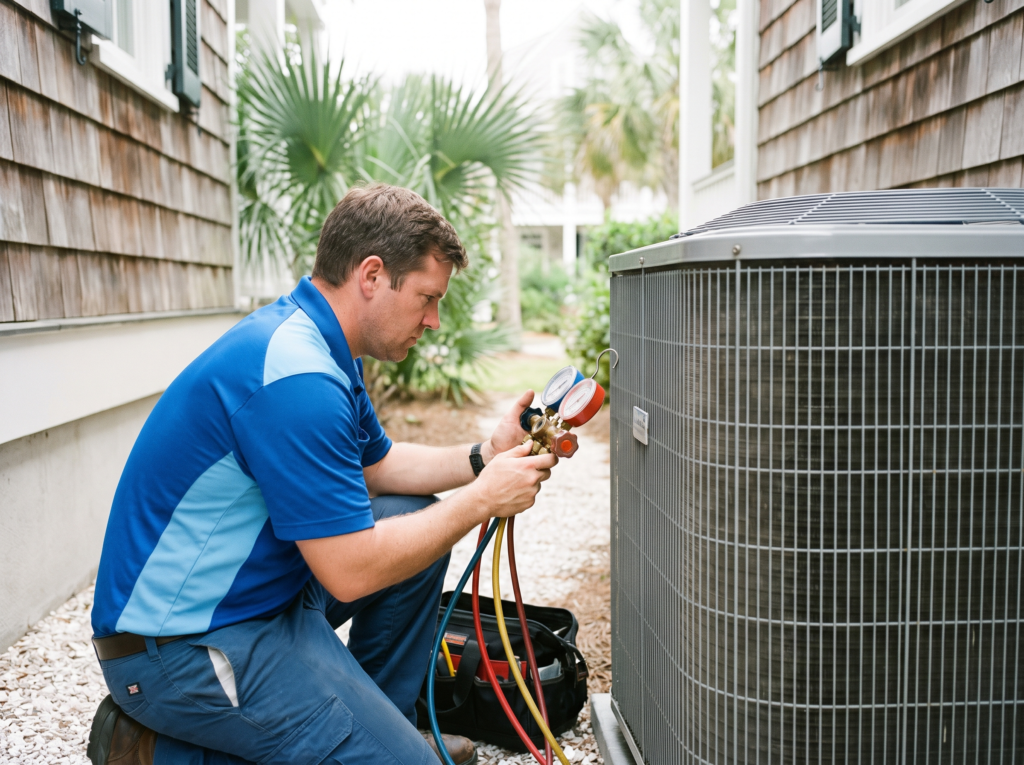
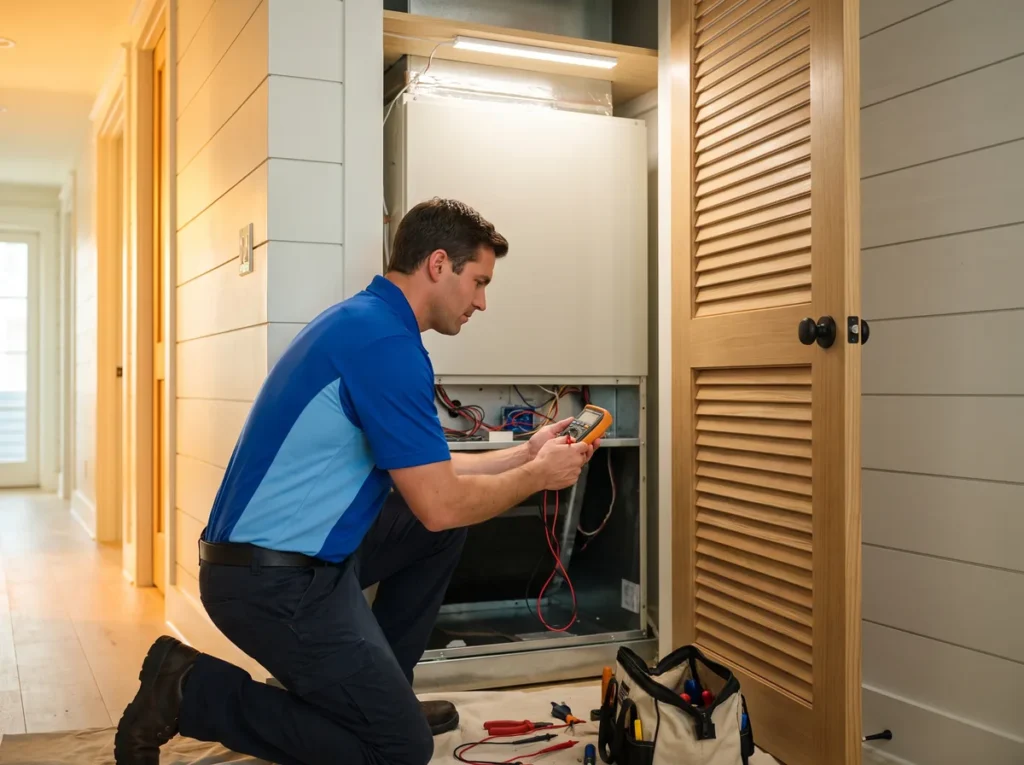
Emergency heat on a heat pump thermostat shuts the heat pump off completely and heats your house using only the electric backup strips in the air handler. It is not a boost setting and it is not for cold weather generally. It is for one situation: the outdoor unit has failed or is iced solid, and you need heat until somebody can get to it. Used any other way it costs roughly three times as much as normal heating for the same warmth.
It is one of the most commonly misunderstood controls in a Lowcountry house, partly because the word “emergency” suggests it is the setting for a cold snap. It is not.
Auxiliary heat and emergency heat are not the same thing
These get used interchangeably and they are different. Getting them straight is most of the battle.
Auxiliary heat (AUX)
This is automatic. The thermostat decides, on its own, that the heat pump needs help and brings the backup strips in alongside it. Both run together. It happens on genuinely cold mornings and during defrost cycles. You do not control it directly, you just see an indicator light up.
Auxiliary heat is a normal part of how a heat pump works in winter. It should be brief and occasional.
Emergency heat (EM HEAT)
This is manual. You choose it. It locks the compressor out entirely — the outdoor unit does not run at all — and runs the strips alone, for as long as it is selected.
Nothing turns it off but you. That is the detail that costs people money: there is no automatic exit. Switch it on in a January cold snap, forget about it, and you are still running it in March.
The one time to use it
Use emergency heat when the heat pump cannot run and you need heat in the meantime. In practice that means:
- The outdoor unit is not running at all and the house is getting cold.
- The outdoor unit is encased in ice rather than lightly frosted. Continuing to run the compressor in that state can bend fan blades and damage the compressor, so locking it out protects the equipment.
- You can hear a grinding, screeching or hard electrical hum from the outdoor unit. Stop running it.
- Something physical has happened to it — a fallen limb, a flooded pad, visible damage after a storm.
In those cases, switch to EM HEAT, keep the house liveable, and get it looked at. It is a bridge, not a mode you live in.
When not to use it
Not for a cold snap. Our coldest mornings are usually in the 20s and 30s, and a correctly working heat pump handles those with brief auxiliary assistance it brings in by itself. You do not need to help it.
Not to warm the house faster. It will not. The strips produce hotter air, so the register feels better on your hand, but the rate at which your house gains temperature is limited by capacity and airflow. You are paying a premium for a sensation.
Not as a comfort setting because heat pump air feels cool. Heat pump supply air runs about 90°F to 100°F, which is cooler than your skin. That is normal and it is why we wrote separately about heat pump air feeling cool.
Not all winter because somebody told you it was the winter setting. We find houses every year running on strips from November to March, and the bill tells the story long before anybody checks the thermostat.
Why it costs what it does
A heat pump moves existing heat from outdoor air into your house. Depending on conditions it delivers two to four units of heat for every unit of electricity it draws. Resistance strips convert one unit of electricity into one unit of heat. There is no way to improve on that; it is physics, not efficiency ratings.
So for the same warmth, strips cost roughly three times as much. Across a Lowcountry winter, a house left on emergency heat can show a bill increase large enough that people assume there has been a metering error. If yours has jumped, our piece on winter bill spikes walks through the other causes too.
How to tell if yours is on right now
Go and look at the thermostat. Depending on the model you may see:
- A mode selector reading EM HEAT, EMERGENCY HEAT or sometimes just EM.
- An indicator light, often red or amber, labelled EM or AUX.
- On a touchscreen or app, a system mode list with Emergency Heat as an option below Heat, Cool and Auto.
Then go outside while the system is running and put your hand near the outdoor unit. If the house is calling for heat and the outdoor fan is completely still — not pausing for a defrost cycle, but simply never running — you are either on emergency heat or the outdoor unit has a fault.
If the mode says EM HEAT and the outdoor unit is otherwise healthy, switch to HEAT. That is the whole fix, and it is free.
Things that quietly put you on backup heat
Even with the mode set correctly, a few situations have the strips running far more than they should:
- A deep overnight setback. Recovering eight degrees at six in the morning looks, to the thermostat, like a heat pump that is failing. It calls the strips. Two or three degrees is plenty with a heat pump, and a well-configured smart thermostat with adaptive recovery handles it better.
- A thermostat not set up as a heat pump thermostat. Wrong equipment type, wrong balance point, or a missing reversing valve configuration. Extremely common after a DIY swap.
- A clogged filter or closed registers. Low airflow raises run times and pushes the thermostat toward backup.
- A real fault in the heat pump. Low charge, a defrost problem, a weak compressor. The strips cover for it silently, and the first thing you notice is the bill.
If you have had to switch to emergency heat
That means something has gone wrong with the outdoor unit, and the strips are keeping you going in the meantime. Two things worth knowing:
First, the strips may not hold the house on a genuinely cold night, because they are sized to assist rather than to be the whole heating system. Do not be surprised if you cannot reach your usual setpoint.
Second, get it diagnosed rather than living on it, because you are paying triple the whole time. A heat pump repair visit will find out whether it is a capacitor, a contactor, a defrost board or something larger. If you have a gas furnace rather than a heat pump, none of this applies and the equivalent conversation is about furnace repair instead — though in this climate most of us have heat pumps.
Preventing the whole situation
The faults that force people onto emergency heat are, with few exceptions, measurable before they strand you. A pitting contactor, a capacitor reading below spec, a charge sitting a little low, a defrost sensor drifting. A heating maintenance visit before the first cold weather is when those get caught, and it is also when we check that your thermostat is configured as a heat pump thermostat in the first place, which is a surprisingly common miss.
If you need somebody out
Call or text 843-609-5740, or book online. We are not a 24-hour emergency service, so after-hours calls reach our answering service rather than a technician — but emergency heat exists precisely so you can stay warm overnight, and we will get you the earliest appointment we have. We work across West Ashley, Charleston, Summerville, Mount Pleasant and the surrounding Lowcountry.