A pre-season heating tune-up is one visit, usually an hour to two, where a technician runs your system in heating mode, cleans what collected over the summer, measures the electrical parts that fail first near the water, and hands you a written picture of what they found. If you are comparing an HVAC maintenance plan, Charleston homeowners get the most out of one in October, before the first cold night turns a small problem into an emergency. Here is the whole visit, step by step.
What an HVAC Maintenance Plan in Charleston Actually Covers
Strip away the brochure language and a seasonal heating visit is five things:
- Test. Run the system in heating mode and measure what it does, not what the thermostat claims.
- Clean. Filter, blower wheel, drain pan, outdoor coil.
- Measure and tighten. Electrical connections, motor amp draw, capacitors, safety controls.
- Inspect. Heat exchanger or heat strips, ductwork, insulation, the cabinet itself.
- Report. Photographs of what was found, and a firm price before any repair starts.
A plan simply bundles two of those visits a year, one before cooling season and one before heating season, and adds scheduling and pricing benefits on top. Our Harbor Club membership tiers are built that way: two tune-ups a year, priority scheduling, no overtime charges, and a discount on repairs. Coastal is $249 a year ($21 a month) and Oasis is $399 a year ($33 a month), with an Oceanside tier above them. The wider checklist for the season lives in our Lowcountry guide to your first cold snap.
Before Anyone Touches the Equipment
You get a real arrival window and a text when the technician is on the way, because “sometime Tuesday” is not a plan. Shoe covers go on at the door.
The first few minutes are conversation, not tools. When did you last run the heat? Is there a room that never gets comfortable? Is anyone in the house elderly, very young or unwell? That last answer matters: if the visit turns up something unsafe, the office moves those households up the schedule.
Step One: The Thermostat and the Changeover
The technician switches the thermostat to heat and watches what the system does. On a heat pump, which is what most Lowcountry homes run, a valve inside reverses the flow of refrigerant so the outdoor unit pulls heat into the house instead of pushing it out.
Air from the vents in heating mode can feel cooler than your hand and still be correct, which is the whole subject of why a heat pump blows air that feels cool. The technician also confirms that auxiliary heat, the electric strips that help out on a genuinely cold morning, comes on when it is needed and shuts off when it is not. Strips that run all winter are an expensive way to heat a house.
Step Two: Inside the Air Handler or Furnace
Filter first. A clogged filter is the most common cause of a weak, expensive-feeling system, and changing it is one of the few jobs we want homeowners doing between visits. Next comes the blower wheel, which picks up a film of dust and coastal grit that quietly strangles airflow. The drain pan and condensate line get cleared, because a Lowcountry system sheds water nearly year round.
On a gas furnace, the technician inspects the heat exchanger, the metal wall that keeps combustion gases out of the air you breathe, along with the burners, the flame sensor and the safety switches. On an electric air handler, that same attention goes to the heat strips and their contactors.
Step Three: Outside, Where Salt Air Does Its Work
This is the part a coastal tune-up has to get right. The outdoor coil gets a gentle rinse, and then the technician looks hard at the metal, because two kinds of damage show up near the water.
Galvanic corrosion happens where two different metals meet, aluminum fins against copper tubing, and salt-laden moisture turns that joint into a tiny battery that eats one of the metals away. Pitting corrosion is narrower and meaner: it punches small holes straight through sheet metal, usually the cabinet and the fan housing. Neither is cosmetic, and both help explain why equipment life varies so much across one metro area. Inland systems often last 12 to 15 years, while barrier-island systems often last 8 to 12. Our longer piece on what salt air does to Charleston cooling equipment walks through the mechanics.
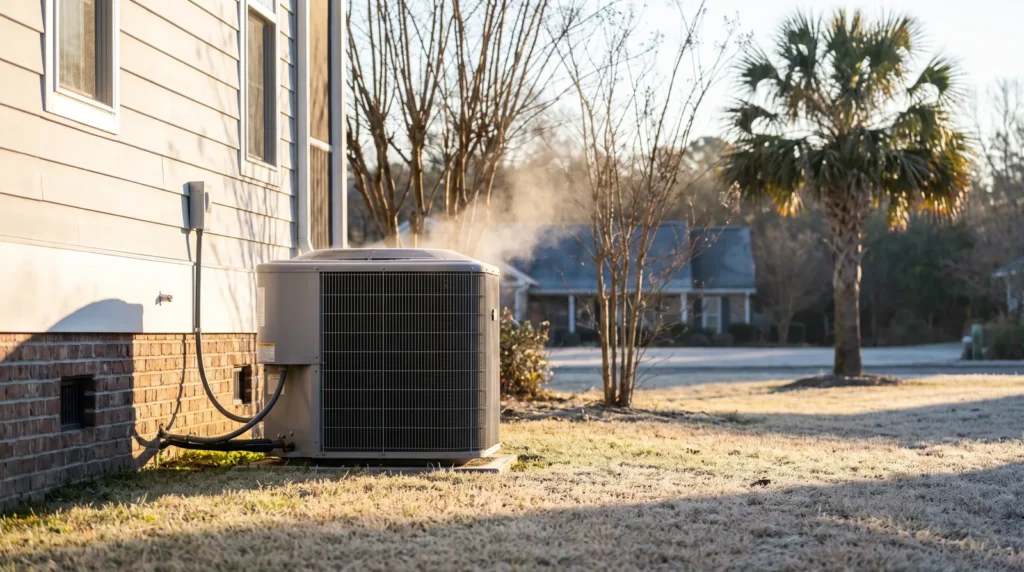
A heat pump melts frost off its own outdoor coil at intervals, so the defrost cycle gets tested too; a board that quietly died in July shows up as a unit sealed in ice in January.
Step Four: The Checks That Are About Safety, Not Comfort
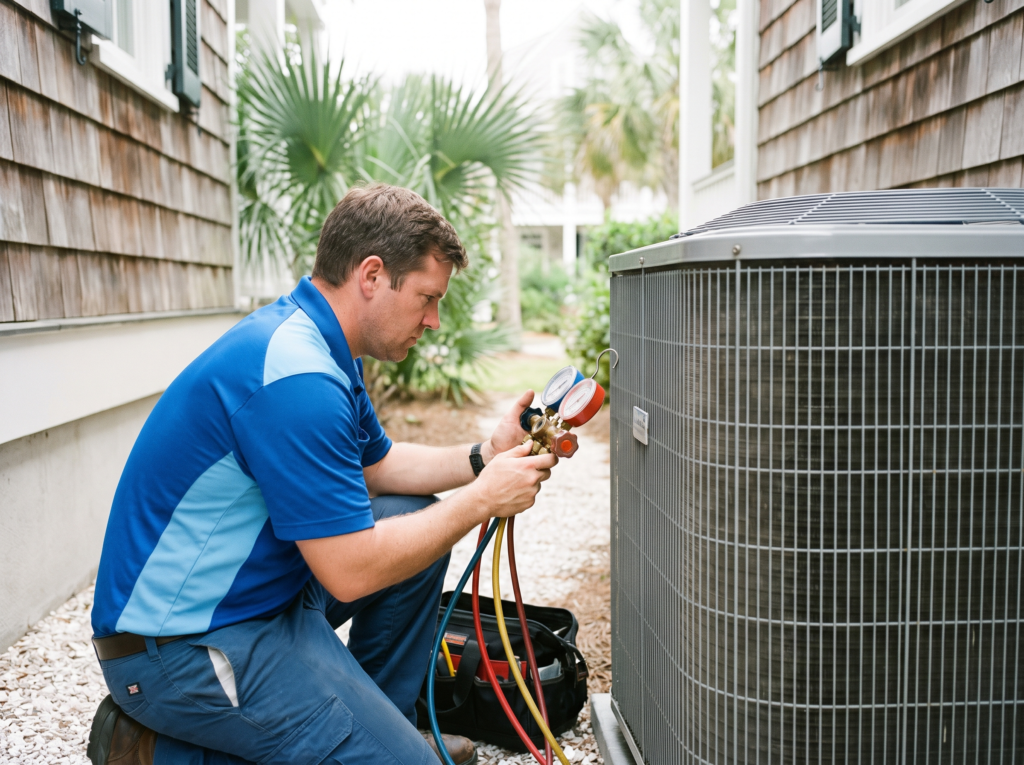
Electrical parts are the usual suspects on the coast, so the technician measures amp draw on the compressor and blower motor, tests capacitors (the components that give a motor its starting push), and checks contactors and wiring for corrosion. On gas equipment, combustion safety gets its own pass.
There is also a rule we repeat on every visit. If you smell something burning, if the breaker trips again after you reset it once, or if you hear electrical humming from the equipment, shut the system off at the thermostat, leave the panels closed and call us. Those three symptoms are not wait-and-see. Refrigerant, sealed parts and anything behind an access panel are technician work, every time.
What a Tune-Up Will Not Do
It will not make undersized ductwork big enough, and it will not turn a 14-year-old barrier-island heat pump into a new one. It will not promise that nothing breaks, because parts fail. What it does is move most failures from 9 p.m. in January to 10 a.m. in October, when there is time to think about the repair and get an honest quote.
It also will not cure humidity on its own. If your house is cool but still feels damp, that is a separate diagnosis: see why a cool house still feels clammy.
A Plan, or Just One Visit?
Both are reasonable. A single visit makes sense if you just bought the house, or if someone quoted you a new system and you want a second set of eyes. A plan makes sense if you would rather the visits happened without you remembering them, and if priority scheduling during a cold snap is worth paying for.
Our published specials include a $49 seasonal tune-up and $50 off any HVAC repair for new customers, one per household, at residential addresses inside our service area; current terms are on the specials page. Second-opinion estimates on a quoted replacement are free. Financing is available through third-party lenders with approved credit, and current offers vary.
Book It Before the First Cold Night
Oceanview Heating and Air is a local team from Summerville to the sea, and calls go to the Farm Road office rather than a national desk. Repairs are same-day in most cases, and every visit carries our 100% satisfaction guarantee.
Call or text (843) 609-5740 to schedule a heating maintenance visit, or send the details through our contact page for the Summerville office and we will find you a window. The first cold night does not send a warning.
Frequently asked questions
How often should an HVAC system be serviced in the Lowcountry?
Twice a year is the standard here: once before cooling season and once before heating season. Coastal systems run more hours than systems inland and sit in salt air the whole time, so the second visit is not padding. If you can only manage one, make it the heating visit in the fall, since that is when a failure is hardest to get help for quickly.
Is a maintenance plan worth it if my system is only a few years old?
New equipment is exactly when maintenance pays, because you are protecting something that still has most of its life ahead of it. Many manufacturers also expect documented annual service as a condition of their parts warranty, so the paperwork from each visit has value of its own. Check your own warranty terms, then decide.
How long does a pre-season heating tune-up take?
Plan on an hour to two hours for one system. A gas furnace with combustion checks takes longer than an electric air handler, and a technician who finds corrosion or a weak capacitor will spend time documenting it with photographs. If you have two systems, expect close to double.
What can I safely do myself between visits?
Change or clean the filter on schedule, keep the thermostat settings sensible, clear leaves and pine straw away from the outdoor unit so it can breathe, and rinse the outdoor coil gently with a garden hose. If a breaker trips, you can reset it once. Beyond that, leave the access panels closed: electrical components, sealed parts and refrigerant are not homeowner territory.
Does a tune-up cover both heat pumps and gas furnaces?
Yes, though the checklist changes. A heat pump visit centers on the changeover to heating, the defrost cycle and the outdoor unit. A gas furnace visit adds combustion safety, the burners, the flame sensor and an inspection of the heat exchanger. Plenty of Charleston-area homes have one of each across two zones, and each gets its own pass.