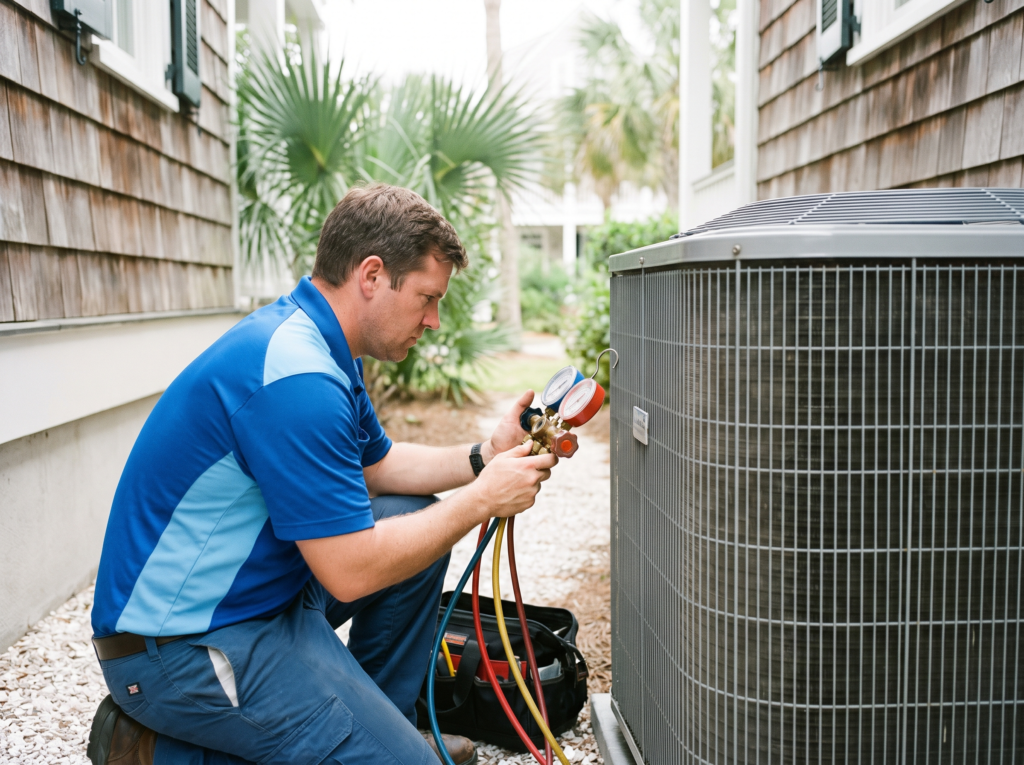
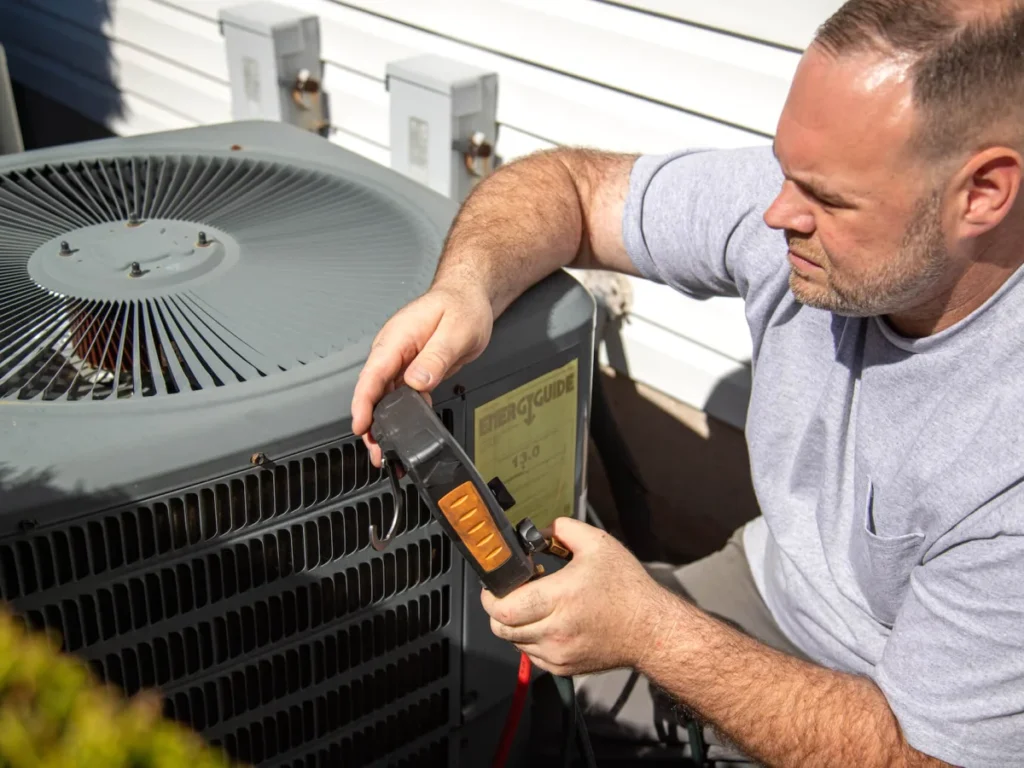
If your heat pump is blowing air that feels cool while the thermostat is set to heat, the first thing to know is that it may be working exactly as designed. Heat pump supply air normally comes out somewhere around 90°F to 100°F, which is cooler than your 98.6°F hand, so it can feel chilly even when the system is heating properly. It becomes a real fault when the air is genuinely cold, when the house never reaches setpoint, or when the problem is paired with a frozen outdoor unit or a breaker that keeps tripping.
Below is how to tell those situations apart without guessing, in the order we would check them ourselves.
First, understand what a heat pump actually does
A furnace burns fuel and produces air in the 120°F to 140°F range. You feel that on your arm as unmistakable heat. A heat pump does not create heat at all. It moves heat that already exists in the outdoor air into your house, running the air conditioning cycle backwards.
That is a far more efficient way to heat a house in our climate, and it is why most of the Lowcountry runs heat pumps rather than furnaces. The trade-off is the supply air temperature. It is warmer than the room, so the house gets warm, but it is cooler than your skin, so standing at a register feels underwhelming.
Plenty of people move here from Ohio or Pennsylvania, feel that air for the first time, and assume something is broken. Usually nothing is.
The quick sanity check
Put a cheap kitchen thermometer in the nearest supply register while the system has been running for ten minutes, then hold it in the return air grille. You are looking for a rise of roughly 20°F to 30°F between the two. If you are getting that, the equipment is making heat and your issue is comfort perception, airflow or distribution rather than a failed heat pump.
If the supply air is the same temperature as the return air, or colder, keep reading.
It is probably the defrost cycle
On a damp morning in the 30s and 40s — which is most of our cold weather — frost forms on the outdoor coil. The system has to melt it off, and the way it does that is by briefly reversing into cooling mode and sending warm refrigerant outdoors.
For those few minutes, the air from your vents is cool. The outdoor unit stops its fan and may put out a cloud of steam. Then it clunks back into heating and carries on. A healthy defrost cycle lasts a handful of minutes and happens occasionally, not constantly.
What is not normal: defrosting every twenty minutes, staying in defrost for a long stretch, or coming out of defrost still visibly packed with ice. That points to a bad defrost board, a failed sensor, a reversing valve that is not shifting cleanly, or a low refrigerant charge. All four are jobs for a heat pump repair visit rather than a homeowner fix.
Check the thermostat before anything else
This sounds too simple to matter. It is the single most common cause we actually find.
- Mode set to COOL. It happens every October in this town. Somebody bumps the mode on a shoulder-season day and nobody notices for a week.
- Fan set to ON instead of AUTO. With the fan locked on, the blower keeps pushing air between heating cycles. That air is room temperature at best, so every register feels like it is blowing cold. Set it to AUTO.
- A new thermostat wired wrong. If the cool air started the day after a smart thermostat went in, the reversing valve wire is the usual suspect. Heat pumps use an O or B terminal that a standard furnace thermostat does not, and a DIY swap gets it backwards often enough that we see it several times a season. The symptom is exact: the system runs cooling when you call for heat.
- Dead batteries. A thermostat with failing batteries can lose its mind in interesting ways before it goes dark.
Then check airflow
A heat pump starved of air cannot deliver heat even when the refrigerant side is perfect.
The filter
Pull it out and hold it toward a light. If you cannot see light through it, it has been in too long. In a Lowcountry house with pets or ongoing construction nearby, a one-inch filter can be done in six weeks, not three months. A badly clogged filter can also push the system into a safety shutdown, which looks like the fan running with no heat at all.
Closed and blocked registers
Closing vents in unused rooms does not save money on a residential system. It raises static pressure, cuts total airflow and makes the rooms you do use worse. Open them. Then walk the house and make sure no sofa, rug or stack of boxes is sitting on a return grille.
Duct leaks
Ducts running through a vented crawlspace or an unconditioned attic are the norm in older homes in West Ashley, James Island and much of North Charleston. When the supply side leaks, the heat you paid for warms the crawlspace. When the return side leaks, the blower pulls in cold outdoor air and mixes it with your heated air before it ever gets to a room. That second one feels exactly like a heat pump blowing cold air, and no amount of work on the equipment will fix it. It needs ductwork repair and sealing.
Faults that need a technician
If the thermostat and airflow check out, the remaining causes are inside the refrigerant circuit or the controls:
- Low refrigerant charge. Refrigerant is not consumed. If the charge is low, there is a leak, and topping it off without finding the leak just sells you the same repair again next winter. On the coast, leaks often trace back to corrosion on the outdoor coil.
- A stuck reversing valve. This is the component that decides whether your heat pump heats or cools. When it sticks or its solenoid fails, the system can run air conditioning in January.
- A failed outdoor fan motor or compressor. If the outdoor unit is silent while the indoor blower runs, the heat has nowhere to come from.
- Tripped auxiliary heat. Most Lowcountry heat pumps have electric backup strips for the handful of genuinely cold mornings. If the strips have a tripped limit or a bad sequencer, you lose your safety net on the coldest days.
- An iced outdoor coil. A thin skin of frost is normal and the defrost cycle handles it. A solid block of ice is not. Shut the system off at the thermostat, let it thaw, and have it looked at before running it again.
What this costs and how we quote it
We will not pretend to price a repair from a blog post, because the honest answer depends on what the diagnosis turns up. A reversing valve is a different conversation from a flipped thermostat wire. What we will do is diagnose it, then put the numbers in writing in front of you — itemized, with the repair figure and, where the system is old enough for it to be a fair question, the replacement figure alongside it. You decide with both numbers visible.
Keeping it from happening again
Most of the mid-winter calls we run on heat pumps are failures that were already measurable in October. A defrost sensor drifting out of range, a contactor pitting, a charge sitting a little low, a capacitor reading under spec. A proper heating maintenance visit before the first cold snap catches those while they are cheap and while you are not sitting in a cold house waiting for a slot.
If you would rather not have to remember to book it, that is what the Harbor Club maintenance plan is for. Two visits a year, scheduled for you, with priority on the calendar when something does go wrong.
When to stop troubleshooting and call
Run the thermostat and filter checks yourself. Those two cost nothing and solve a meaningful share of these calls. Stop and call us if the outdoor unit is iced solid, if the breaker trips, if you hear a hard electrical hum or a grinding noise, or if the house simply is not holding temperature on a cold night.
Call or text 843-609-5740, or book online. We are not a 24-hour emergency service, so an after-hours call reaches our answering service rather than a technician — but we will get you the earliest slot we have. We cover Summerville, Charleston, Mount Pleasant and the rest of the Lowcountry from our shop on Farm Road.