The first real cold night in the Lowcountry usually arrives in late October or November, and it is the night most heating problems announce themselves. If you have been searching “heating maintenance Charleston SC” and wondering whether a pre-season check earns its keep on a coastal home, the short answer is yes, and for different reasons than inland. Salt air, five idle months and humidity that never fully leaves all change what needs looking at. Here is the whole job, start to finish.
What heating maintenance in Charleston, SC actually covers
A pre-season heating check is not a quick look and a sticker on the side of the furnace. On a Lowcountry system it is about an hour of structured inspection, and most of that hour is measurement rather than opinion.
A technician reads the temperature rise across the system, inspects and tightens electrical connections that a long humid summer has loosened or corroded, tests the safety controls that shut equipment down when something goes wrong, looks at the heat exchanger or the reversing valve depending on what you have, cleans what can be cleaned, and writes the readings down so next year’s numbers mean something. A measurement only becomes useful when there is a prior one to compare it to.
Three things make the Charleston version of that visit different from the same visit in Columbia or Greenville: the salt in the air, the length of the cooling season, and the fact that most homes here heat with a heat pump rather than a furnace. Each one changes what fails first and what a technician looks at first. Our October companion piece on what a pre-season heating tune-up includes, start to finish walks the checklist item by item. This guide is about why each item matters on a house within reach of the water.
Why salt air changes the heating conversation
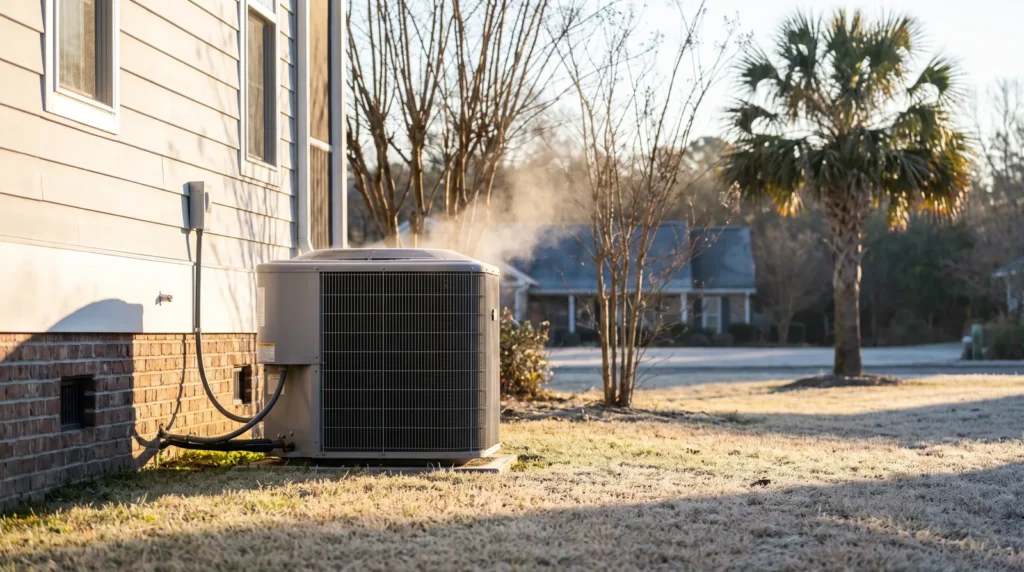
Salt air is not only a summer problem. The outdoor half of a heat pump runs all winter, and whatever it picked up over a long coastal summer shows up the first time you ask it for heat.
Two kinds of corrosion do most of the damage, and they work differently. Galvanic corrosion happens when two different metals sit against each other with salty moisture between them. The aluminum fins and copper tubing in a coil are a classic pair, and one metal slowly sacrifices itself to protect the other. Pitting corrosion is narrower and meaner. Chloride from sea spray breaks through the thin protective layer on a metal surface in one small spot and eats a pinhole straight down. A coil can look fine from three feet away and still be losing refrigerant through a pit that takes a leak detector to find.
That is why equipment life reads differently depending on where your house sits. Inland systems often last 12 to 15 years; on the barrier islands, 8 to 12 years is often closer to the truth. Our article on what salt air does to coastal equipment covers the chemistry in more detail, and this month’s piece on equipment lifespan on the coast puts planning numbers around it. A system on Folly Beach or Sullivan’s Island is not being treated unfairly. It is simply working in a harder place than the brochure assumed.
What five idle months do to heating equipment
Charleston runs its air conditioning from roughly April into October. That means the heating side of your system, whatever it is, has been sitting still for most of the year, and sitting still causes its own set of problems.
Dust and pine pollen settle on burners and heat strips over the summer, which is why the first run of the season often carries a faint burning smell for a few minutes. That short, dusty smell is normal. A smell that keeps going, or one that turns sharp and plastic or electrical, is not, and it is a reason to shut the system off at the thermostat and call.
Idle time also invites company. Wasp nests, spider webs and rodent nesting material turn up in flue pipes, cabinets and outdoor units every October. Capacitors that were weak in August quietly fail over the winter. Defrost boards and reversing valves that have not moved in five months sometimes stick on their first cycle.
Two of the most common October calls have ordinary explanations. If your heat pump is running but the air at the vents feels cool on your skin, read why a heat pump blows cool air in October before you assume it is broken. If a furnace will not start on the first cold night, there are three safe checks worth running before you call.
The checks a homeowner can safely do this weekend
None of these need tools, and none of them involve opening a panel. Anything behind a panel is technician work.
- Change the filter. ENERGY STAR guidance is to check filters monthly and change them at least every three months. Coastal pollen and humidity often push that shorter, and a loaded filter is the most common cause of weak airflow and a system that short-cycles.
- Put fresh batteries in the thermostat and confirm it is set to Heat rather than Emergency Heat or Auxiliary.
- Walk the house and open every supply vent and return. Closing vents in unused rooms does not save money on most systems; it raises pressure in the ducts and strains the blower.
- Clear two feet around the outdoor unit. Pine straw, leaves and lattice all restrict the airflow a heat pump needs in heating mode.
- Rinse the outdoor coil gently with a garden hose if you live near the water. A monthly freshwater rinse is the cheapest salt defense there is. Gentle pressure only, from the outside in.
- Reset a tripped breaker once. If it trips again, leave it off and call. A breaker that keeps tripping is reporting a fault, not being stubborn.
One more fall question deserves its own answer: covering the outdoor unit. On the coast that usually does more harm than good, and our piece on covering the outdoor unit for winter explains what a cover traps against the metal.
What a technician checks that you cannot
The rest of the visit needs gauges, meters and a license. This is the part of a pre-season check that finds problems while they are still small and still cheap.
On a gas furnace
The heat exchanger gets inspected for cracks, because a cracked exchanger is how combustion gases reach the air you breathe. The flame sensor and igniter are cleaned and tested, the flue is checked for blockage and proper draft, and gas pressure and temperature rise are measured against the manufacturer’s specification. A furnace that heats well and still tests out of spec is a furnace wearing itself out early. If something is found, furnace repair gets quoted before any work starts, not after.
On a heat pump
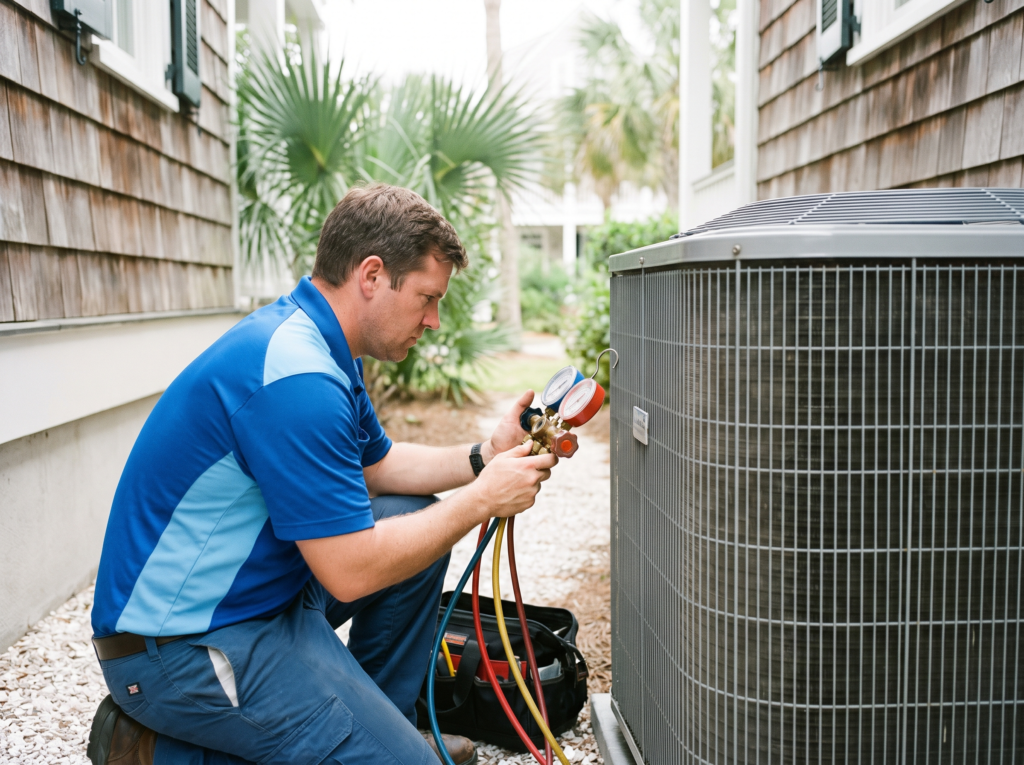
Refrigerant charge is verified with gauges rather than guessed, because a coastal coil that has been pitting for a season can run slightly low without anyone noticing in August. The defrost cycle is forced and watched, since a failed defrost board leaves an outdoor coil icing over on a damp 38-degree night. Amp draw on the compressor and fan motor, contactor condition and the auxiliary heat strips all get checked. Worn parts turn into a heat pump repair quote with photographs of exactly what was found.
On the ductwork
In a Lowcountry crawlspace or a vented attic, duct leaks pull damp, unconditioned air into the system all winter. Disconnected boots and crushed flex runs are common in homes that have had crawlspace work done. When a duct problem is what is actually making a room cold, ductwork repair solves the comfort complaint that a bigger system never would.
Setting the thermostat for a mild coastal winter
A heat pump heats differently than a furnace, and the difference confuses plenty of new coastal homeowners. A furnace delivers short bursts of hot air. A heat pump delivers a long, steady stream of air that is warmer than the room but cooler than your skin, so it can feel cool at the vent while the house is heating perfectly well.
That behavior leads to the most expensive thermostat habit in Charleston: setting the temperature back ten degrees at night, then jumping it back up in the morning. A heat pump cannot recover that fast on its own, so it calls in the electric auxiliary heat strips, which cost far more to run. Modest setbacks of two or three degrees work; dramatic ones get paid for on the power bill.
Emergency Heat is for a failure, not a cold snap. It locks out the heat pump and runs the strips alone, so if you need it to stay warm, something is wrong and the system needs a look. A programmable or smart thermostat installed and configured for heat pump staging handles the recovery math for you, which matters more here than in a climate where a furnace does all the work.
Humidity does not leave when summer does
Charleston winters are mild and damp. A house can hit its thermostat setting in January and still feel clammy, and running the heat harder does not fix it. Damp winter air carries a second cost too: it makes a 50-degree morning feel colder than it is, which is exactly when people reach for the thermostat.
The causes are usually structural rather than mechanical. A vented crawlspace breathing moist air into the floor system, duct leaks pulling in unconditioned air, and an oversized system that satisfies the thermostat before it has run long enough to do anything about moisture all produce the same complaint. We wrote about a house that feels clammy with the system running for the cooling season, and the mechanics carry straight into winter.
When the building is the problem, a bigger furnace is not the answer. A properly sized whole-home dehumidifier paired with sealed ductwork handles it, and a technician who measures before quoting will tell you which one you actually have.
When to shut the system off and call right away
Most heating problems can wait for a scheduled visit. These cannot. Turn the system off at the thermostat, leave the panels closed and call:
- A burning smell that lasts beyond the first few minutes of the season, or any smell of hot plastic, melting insulation or scorched wiring.
- A breaker that trips more than once.
- Electrical humming, buzzing or clicking from the indoor unit, the outdoor unit or the disconnect box.
- Soot or black streaking around a furnace, or standing water underneath it.
- A carbon monoxide alarm. Get everyone outside first, then call. If you smell gas, leave the house before you call anyone, and call the gas utility or 911 from outside.
Never open a panel, handle wiring or touch refrigerant lines yourself. Those are licensed trades for good reason. Oceanview Heating and Air handles same-day repairs in most cases, and the office prioritizes no-heat calls where someone elderly, very young or unwell is in the home. Say so when you call; it changes where you land in the day.
Repair, replace or keep maintaining: deciding honestly
Every fall, somebody in the Lowcountry is told their system needs replacing when it needs a part. The honest version of this conversation has three inputs: the age of the equipment against where you live, how often it has needed repair lately, and whether it is still keeping the house comfortable.
Age sets the frame. Inland, 12 to 15 years is a common service life; on the barrier islands, 8 to 12 years is often more realistic, because the salt gets a vote. A nine-year-old system three blocks from the marsh sits in a different place than a nine-year-old system in Summerville, even when the model numbers match.
Repair history matters more than age by itself. One capacitor is maintenance. A third repair in two seasons on a corroded coastal coil is a pattern. And if you are weighing what to put in next, heat pump or furnace in the Lowcountry lays out how the two compare in a climate with short winters and long summers.
If you have already been handed a replacement quote, a second opinion costs nothing: a free second-opinion estimate is one of Oceanview’s current specials, alongside $50 off any HVAC repair for new residential customers, one per household. For planned replacements, financing runs through third-party lenders subject to approved credit, and current offers vary, so ask what is available the week you decide.
Booking the visit before the first cold snap
October and early November are the busy weeks, and they get busier the moment the first front comes through. Booking ahead of that front is the difference between a scheduled hour and a wait.
A pre-season heating maintenance visit can be scheduled on its own, currently at the $49 seasonal tune-up price. If you would rather have it handled twice a year without thinking about it, Harbor Club membership starts at $249 a year ($21 a month) for the Coastal tier and $399 a year ($33 a month) for Oasis, with a third Oceanside tier above them. Memberships include two tune-ups a year, priority scheduling, no overtime charges and discounts on repairs.
Oceanview Heating and Air works out of 126 Farm Road, Suite A in Summerville, and its service-area pages cover 17 Lowcountry communities, from Moncks Corner to Kiawah. Calls reach the Summerville office rather than a national call center, you get a real arrival window and a text when the technician is on the way, and every visit is backed by a 100% satisfaction guarantee. As of publication, the company’s site lists a 5.0-star rating from more than 1,000 Google reviews.
Call or text (843) 609-5740, or book a visit through the Summerville office, and get the heating side settled before the first cold night asks the question for you.
Frequently asked questions
How often should you get your heating system serviced?
Once a year before heating season is the standard for a gas furnace. A heat pump is the exception that matters most here, because the same equipment heats and cools, so it earns two visits a year in the Lowcountry: one before summer and one before the first cold night. Homes within sight of the water benefit from that second visit the most, since the outdoor unit sits in salt spray all year.
What does heating maintenance include?
A pre-season visit measures temperature rise, tests the safety controls, inspects electrical connections and either the heat exchanger or the reversing valve, cleans the parts that can be cleaned, and documents every reading. On a heat pump it also includes forcing a defrost cycle and verifying the refrigerant charge with gauges. The written readings are the part people overlook; they are what turns next year’s visit into a comparison instead of a fresh guess.
What is the 5,000 rule for HVAC?
It is rough shorthand, not a standard. You multiply the age of the system in years by the estimated repair cost, and if the result clears 5,000, the rule says lean toward replacement. It works as a gut check and no more, and on the coast it tends to understate the age question, since salt-exposed equipment on the barrier islands often reaches 8 to 12 years where inland systems often reach 12 to 15. A technician’s reading of the actual condition beats the arithmetic.
Where can I get my HVAC repaired in Charleston, SC?
Oceanview Heating and Air repairs air conditioning, heat pumps, furnaces, ductwork and water heaters across Greater Charleston from its Summerville office at 126 Farm Road, Suite A. Calls and texts to (843) 609-5740 reach that local office rather than a national call center, and repairs finish same-day in most cases because the vans carry common parts. New residential customers can currently take $50 off any HVAC repair, one per household.
Is it too late for a tune-up after the first cold night?
No. A pre-season visit is easier to schedule in early October, but the checks are the same in December and the problems they find are the same problems. The only real difference is the calendar: once the first front moves through, no-heat calls take priority, so a maintenance appointment may sit a little further out.