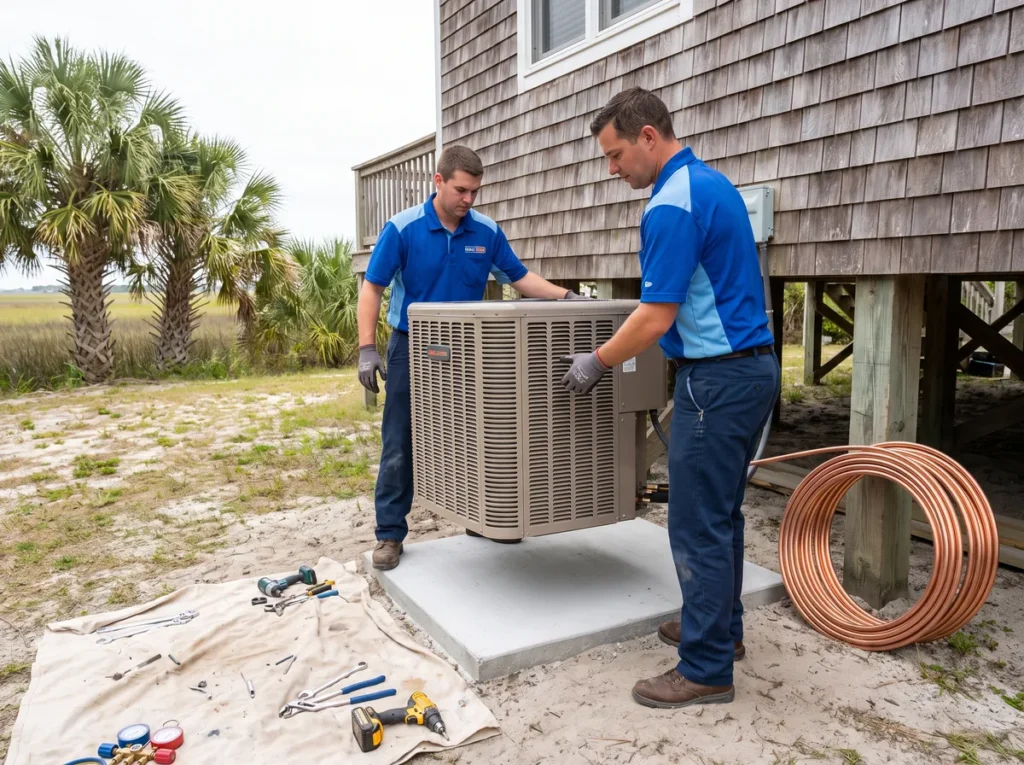

An air conditioner in the Lowcountry works roughly eight months a year. The same unit in Pennsylvania might run three. Manufacturers write their maintenance intervals for the average of the country, which means that down here, annual service is not a nice-to-have — it is the difference between a system that reaches fifteen years and one that quits at nine.
A tune-up is also the cheapest diagnostic you will ever buy. Most of the failures we get called out for in July were visible in April, as a weak capacitor reading, a coil starting to load up, or a drain line already half blocked.
What is actually on the checklist
A real tune-up is measurement, not a walk-around with a flashlight. Here is what a technician does at your house:
- Wash the outdoor condenser coil. Not a quick spray — a proper cleaning that gets the pollen, grass and dirt out from between the fins.
- Inspect and clean the indoor evaporator coil and blower wheel. A dirty blower wheel quietly costs you a large share of your airflow.
- Clear and flush the condensate drain line and check the safety switch.
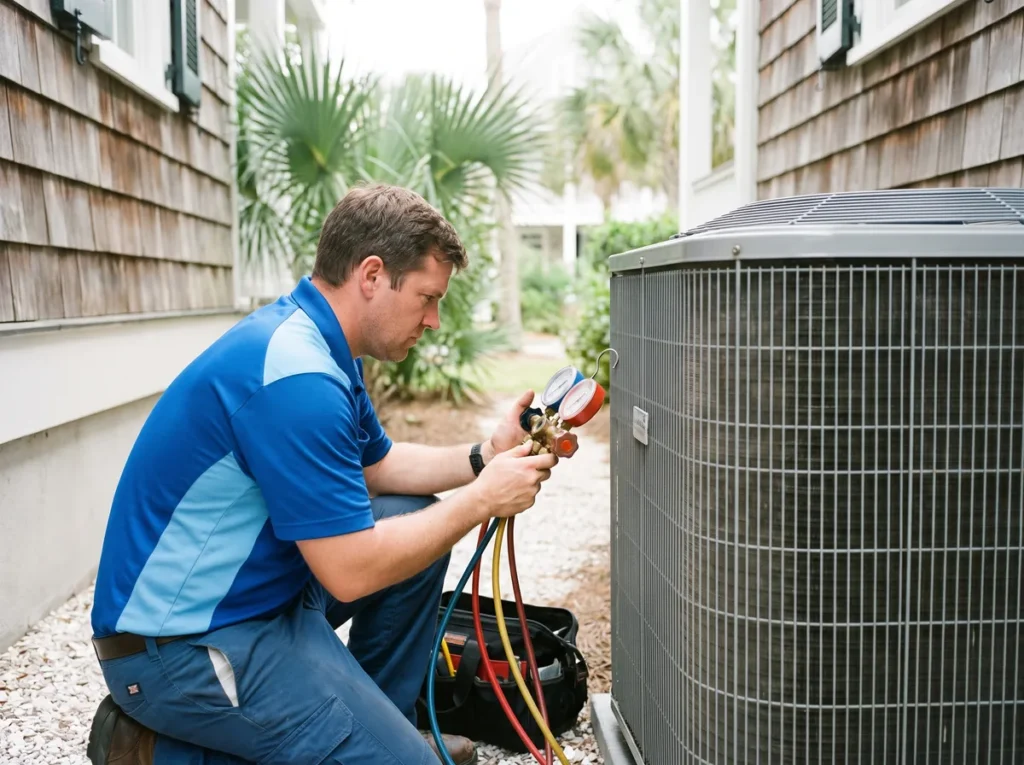
- Read refrigerant pressures and superheat or subcooling to confirm the charge is where the manufacturer wants it.
- Test capacitors, contactors and motor amp draw against their rated values, so we can tell you what is drifting before it fails.
- Check electrical connections for heat damage and tighten what has worked loose from years of vibration.
- Measure temperature split and static pressure across the system to see what the ductwork is really doing.
- Verify thermostat calibration and cycle times.
- Inspect the cabinet, base pan and fins for salt corrosion if you are anywhere near the water.
You get the numbers, not just a checkmark. If something is out of range we show you the reading and explain what it means.
Spring, before the first 95-degree week
There is a week every year, usually in May or June, when the Lowcountry goes from pleasant to brutal in about two days. Everyone turns their system on at once, and the ones that have been sitting idle since October are the ones that fail.
Getting service done in March or April means any weak part is found on a mild day, when we can order it without you sitting in an 88-degree house. It also means you are not competing with every other homeowner in Summerville for the same appointment slot.
Pollen is a real mechanical problem here
Summerville calls itself Flowertown in the Pines for a reason. For a few weeks every spring, everything outside turns yellow, and a condenser coil is essentially a filter sitting in the middle of it.
Pollen packs into the fins and chokes off the airflow the system needs to reject heat. The unit runs longer, works harder, and runs hotter head pressure than it was designed for. Indoors, your filter loads up far faster than the box says. During pollen season a one-inch filter may need changing monthly, and if anyone in the house has allergies it is worth talking about better filtration rather than just buying filters more often.
Condensate drains, and the ceiling they take out
Your air conditioner pulls gallons of water out of the air on a humid Charleston day. All of it has to leave through a small PVC line, and in this climate that line grows algae and biological sludge quickly.
When it blocks, the water backs up. If the unit is in the attic, which it usually is around here, that water ends up in the ceiling of whatever room is underneath. We flush the line, treat it, and confirm the float safety switch actually shuts the system down if it ever does clog. It is a five-minute job on a maintenance visit and a five-figure problem when it is ignored.
Refrigerant charge, honestly
Refrigerant is not a consumable. Your system does not use it up. If it is low, there is a leak, and adding more without finding that leak is putting off the same conversation until next season at your expense.
We check the charge every visit and we tell you the truth about it. A slightly low charge quietly wrecks efficiency and eventually kills compressors, so it is worth catching. If we find a leak, we will find where it is before we talk about topping anything up, and if it turns out the system is not worth chasing, we will say that too before recommending replacement.
The maintenance plan
Most people intend to schedule service and then the season gets away from them. Our Harbor Club membership takes that off your plate: we contact you, we handle the scheduling, and members go to the front of the line when something does go wrong. If your system is still cool but the house feels damp, ask us about a whole-home dehumidifier while we are there — that is a comfort problem maintenance alone will not solve.
To book a tune-up, call or text 843-609-5740 or request a visit online. If something breaks between visits, repair service is a phone call away.