If your electric bill jumps sharply in a Lowcountry winter, the cause is almost always the backup heat strips in your air handler running more than they should. Those strips use roughly three times the electricity of the heat pump itself for the same amount of heat, and a handful of common faults and settings will have them running on a 50°F day when the heat pump alone could handle it easily. It is rarely the heat pump being inefficient. It is usually the expensive backup doing work the cheap part should be doing.
Here is what to check, in the order that finds it fastest.
What the strips are and why they cost so much
Almost every heat pump in the Charleston area has electric resistance heat strips sitting in the air handler, downstream of the coil. They are the same technology as a toaster: current through a wire, and the wire gets hot.
Resistance heat is perfectly efficient in the narrow sense — every watt becomes heat — but it only ever gives you one unit of heat per unit of electricity. A heat pump moves heat rather than making it, so it delivers two to four units of heat per unit of electricity. That ratio is the whole story. Same warmth, three times the money.
The strips exist for two legitimate reasons: to cover the handful of genuinely cold mornings when the heat pump cannot keep up on its own, and to offset the cool air during a defrost cycle. Both are short, occasional jobs. If they are running for hours, something is wrong.
Cause one: somebody left it on emergency heat
This is the big one, and it is a single switch.
Emergency heat, sometimes labelled EM HEAT or AUX, locks the heat pump out and runs on the strips alone. It exists for when the outdoor unit has genuinely failed. Flip it on during a cold snap, forget it, and you will heat your house entirely on resistance heat for weeks.
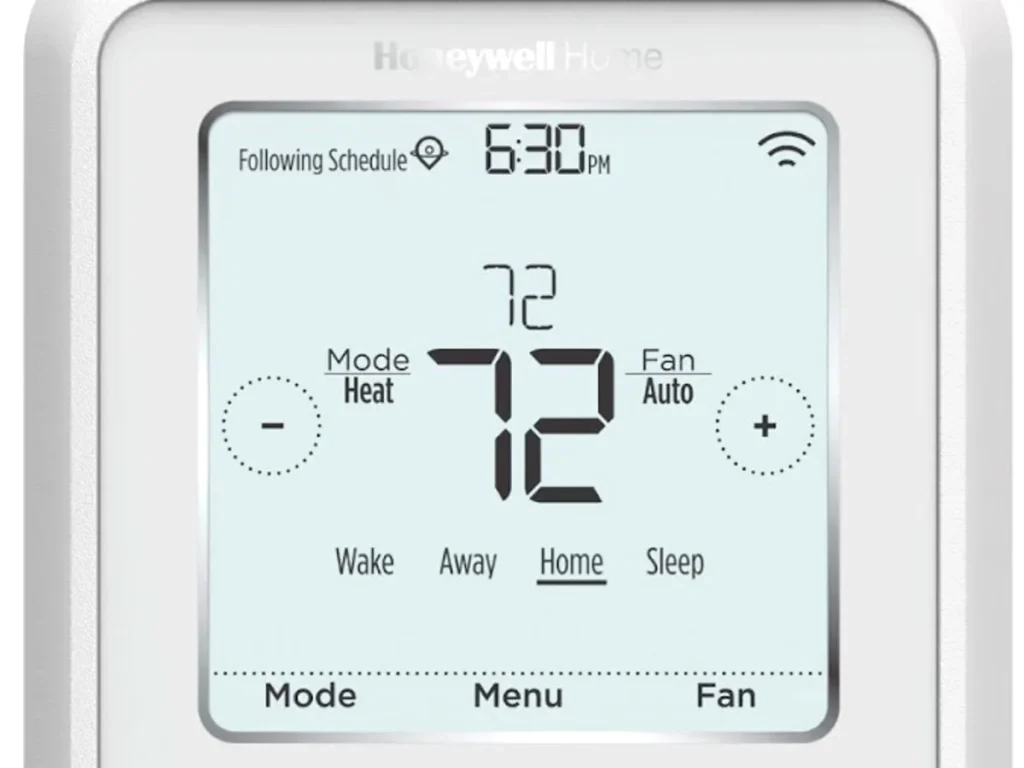
Go and look at your thermostat right now. If it says EM HEAT or EMERGENCY HEAT, and your outdoor unit is working, switch it back to HEAT. People find three-figure differences from that one change. We wrote about what emergency heat actually does in more detail if you want the full picture.
Cause two: the thermostat is calling for aux when it does not need to
Most thermostats have a setting that brings the strips in based on how far the room temperature is below setpoint, or how long the heat pump has been running without getting there. Those settings are often wrong out of the box, and they are almost always wrong after a DIY thermostat swap.
Setback is the trap
Deep night setbacks make sense with a furnace. They backfire badly with a heat pump. If you drop the house to 62°F overnight and the thermostat tries to recover to 70°F at six in the morning, it sees an eight-degree gap, decides the heat pump is losing, and fires the strips to catch up. You save a little overnight and spend a lot at dawn.
With a heat pump, a shallow setback of two or three degrees, or none at all, generally costs less. A properly configured smart thermostat handles this with adaptive recovery — it starts the heat pump early and ramps gently rather than demanding a fast catch-up — but only if it is set up as a heat pump thermostat with the right balance point. A lot of them are not.
The manual override people do by accident
Nudging the setpoint up four degrees because you feel cold right now is the fastest way to turn the strips on. One degree at a time, and wait.
Cause three: a fault that makes the heat pump unable to keep up
If the heat pump cannot hold the house, the thermostat will keep calling the strips in and your bill tells you about it before anything else does. The usual mechanical causes:
- Low refrigerant charge. Reduced capacity, longer run times, strips filling the gap. There is always a leak behind it.
- A defrost fault. A system stuck in or constantly entering defrost spends its time running cooling outdoors while the strips heat indoors. That is the worst possible combination for a bill.
- A dirty or iced outdoor coil. Less heat available from the outdoor air.
- A failed outdoor fan or a weak compressor. The strips become the whole heating system without anybody telling you.
- A stuck strip relay or sequencer. Occasionally the strips simply never turn off. The symptom is an enormous bill with a house that is comfortable, which is why nobody investigates it.
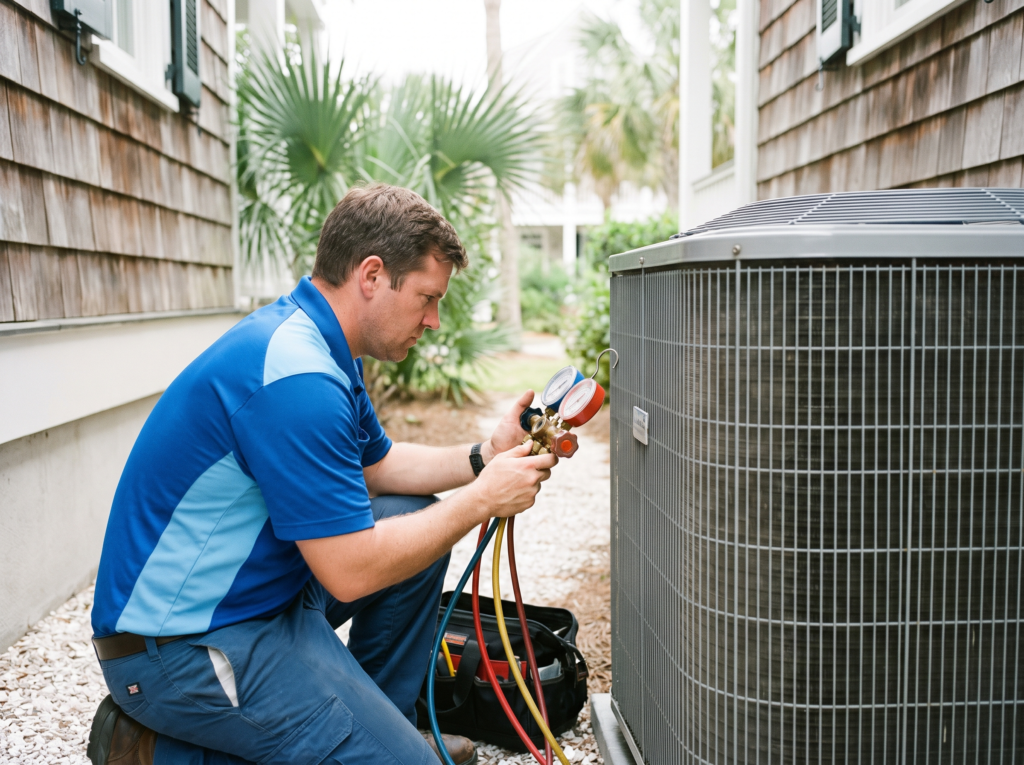
Those are all heat pump repair findings, and most of them are measurable in minutes with gauges and a clamp meter.
Cause four: the house is losing the heat as fast as you make it
A lot of our housing stock leaks. Raised houses over vented crawlspaces downtown and on James Island, 1960s and 70s ranches in North Charleston and Hanahan, attics with compacted or missing insulation in Summerville and Goose Creek.
The duct system is usually the worst offender, because it is the one leak that is actively pressurised. Supply leaks in an attic dump heated air above your ceiling. Return leaks pull 40°F air out of a crawlspace and feed it to the blower, which the strips then have to reheat. Sealing that is ductwork repair, and it is the single highest-return envelope fix on most Lowcountry houses because it helps in summer too.
Cause five: it is not actually the heating
Before you chase the heat pump, rule the obvious things out:
- Billing cycles are not calendar months. A 34-day cycle looks like a spike against a 28-day one.
- Rates change. Check whether your tariff moved.
- Guests over the holidays mean more hot water, more laundry, more cooking, more doors opening.
- An electric water heater is often the second-largest load in a house, and incoming water is colder in January, so it works harder. If yours is old, that is worth looking at on its own.
- Space heaters. One 1,500-watt heater running most of the day is a meaningful line item, and three of them is a heating system you did not plan for.
How to find out which it is, this week
- Look at the thermostat mode. HEAT, not EM HEAT. Fan on AUTO, not ON.
- Watch for the aux indicator. Most thermostats show AUX HEAT or a strip icon when the backup is energised. Check it morning, midday and evening for a few days. If it is lit on a 55°F afternoon, you have found your problem.
- Flatten your schedule. Try a week at one steady temperature with no overnight setback and compare your daily usage in your utility’s online portal.
- Change the filter. Restricted airflow raises run time and can trip the system toward backup heat.
- Feel the supply air. Heat pump air is around 90°F to 100°F. Strip heat is noticeably hotter. If every cycle feels hot rather than mild, the strips are doing the work.
What we do about it
On a bill complaint we check the things that cost money rather than just the things that break: refrigerant charge and capacity, strip amp draw and whether they are staging correctly, the thermostat’s heat pump configuration and balance point, defrost operation, static pressure and airflow, and the condition of the ducts. That is a heating maintenance visit done properly, and on a system that has never had one it frequently pays for itself inside a season.
If you would rather it happened on a schedule without you having to think about it, the Harbor Club plan covers the heating and cooling visits and puts you ahead of the queue when something does break.
What it costs
We will not quote a repair figure in an article, because the honest number depends on what the diagnosis finds — a thermostat configuration change and a stuck sequencer are not the same job. What we will do is tell you what is wrong, put the itemized numbers in writing, and where the system is old enough for it to be a fair question, show you the replacement figure alongside the repair figure.
Call or text 843-609-5740 or book a visit online. Bring your last three bills and we will go through them with you. We cover Goose Creek, Summerville, Charleston, Mount Pleasant and the rest of the Lowcountry.