The first time you switch the thermostat over to heat in October, a heat pump blowing cool air is almost always doing exactly what it was built to do. A heat pump does not burn fuel to make heat. It moves warmth from the outdoor air into your house, which produces supply air that is warmer than your living room but much milder than the blast from a gas furnace. On a damp Lowcountry morning that air can feel chilly on your hand while the house is quietly warming up. A few real faults cause the same symptom, so here is how to tell them apart.
Why a Heat Pump Blowing Cool Air Is Usually Normal
The U.S. Department of Energy describes a heat pump as equipment that moves heat rather than generating it. In heating mode, the outdoor unit pulls warmth out of the outside air and the indoor coil hands it off to your ductwork. The result is a steady, moderate stream of warm air instead of the short, hot bursts a furnace gives you.
The surface of your hand sits around 90 degrees. Air leaving a supply vent in the low 90s is genuinely heating the room and will still feel cool to the touch. Homeowners who switched from a gas furnace notice it right away, and it is the most common first heating call we take every fall.
The test that matters is not how the air feels. It is whether the house reaches the temperature you set in a reasonable stretch of time. Set 70, get to 70, and the system is doing its job. Our guide to heating maintenance in Charleston, SC walks through what a coastal system should do across a full cold snap.
Defrost Cycles Turn the Air Cool for a Few Minutes
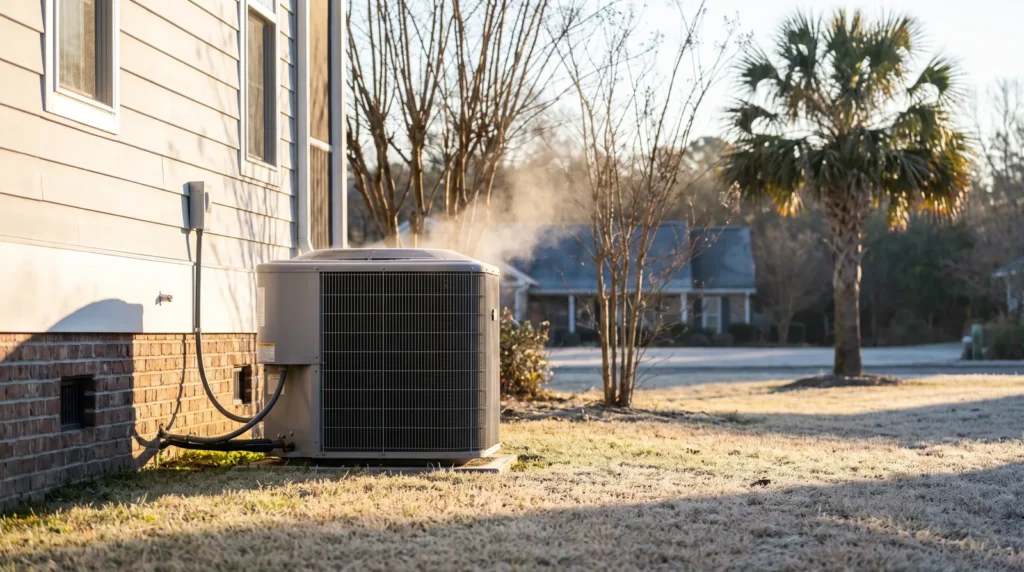
When the outdoor coil drops below freezing, moisture in the air frosts onto it. Frost blocks heat transfer, so the system runs a defrost cycle: it briefly reverses, sends warm refrigerant out to melt the ice, and stops the outdoor fan while it works. Indoors, the vents go cool for a few minutes. Outside, you may see steam rolling off the unit and hear a clunk as it switches over.
That is designed behavior, not a breakdown. Damp air and near-freezing nights arrive together here, which is exactly the condition that frosts a coil. A cycle that lasts a few minutes and ends on its own is fine. A unit that defrosts every fifteen minutes all day, or one still packed in ice afterward, is not.
Two Thermostat Settings That Cause a False Alarm
The fan is set to ON instead of AUTO. On ON, the blower runs around the clock, including the long stretches between heating cycles, and room-temperature air drifting across your feet feels cold. Move the fan to AUTO and the vents only blow while the system is heating.
A setback schedule you forgot about. Programmable thermostats often arrive with a schedule that drops the temperature overnight or during work hours, so the heat that comes on cool in the morning may just be climbing back. Check the schedule screen, not only the current temperature.
When Cool Air Means Something Is Actually Wrong
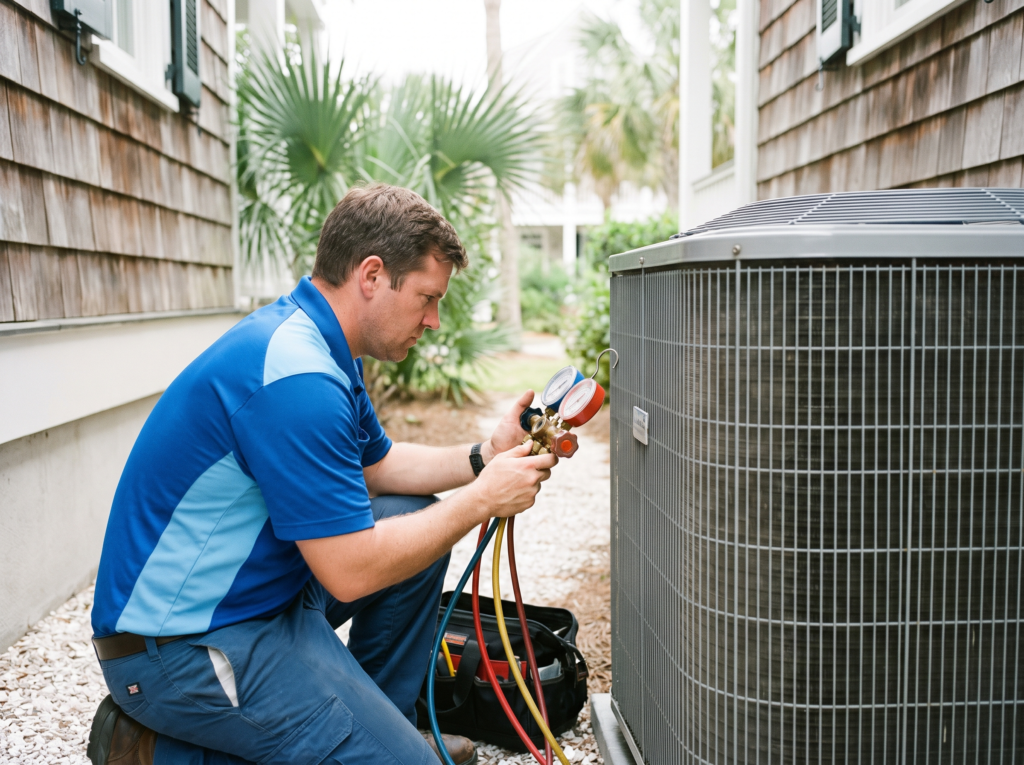
Book a service call when the house never reaches the set temperature after a full day, when the indoor fan runs but the outdoor unit never does, when ice stays on the coil after a defrost cycle, or when the power bill jumps because backup electric heat is carrying the load. A reversing valve that will not switch, a failed outdoor fan motor and a low refrigerant charge all produce cool air in heating mode, and all three take training and gauges to diagnose, which is what heat pump repair is for.
Shut the system off at the thermostat and call right away if you smell burning, if the breaker trips more than once, or if you hear electrical humming or buzzing from the air handler or the outdoor unit. Do not open an electrical panel, and leave sealed parts to a licensed technician.
Coastal Reasons a Heat Pump Runs Weak
Salt air is hard on an outdoor unit, and a weak heat pump is often a corroded one. Galvanic corrosion happens when two different metals touch with salt moisture between them, so one gives up material faster than it should. Pitting corrosion eats pinholes into the aluminum fins and the coil. Either way the coil transfers less heat, and the system works harder for less. Our article on what salt air does to a coastal condenser shows what that damage looks like.
Age matters too, and it is not the same everywhere we work. Inland systems around Summerville and Ladson often last 12 to 15 years; on the barrier islands, from Folly Beach to Isle of Palms and Kiawah, equipment often reaches only 8 to 12. If yours sits in that window and the heat feels weaker every year, how long HVAC equipment lasts on the coast is worth reading before anyone quotes you a replacement.
Four Safe Checks Before You Call
- The filter. A clogged filter starves the indoor coil of air and makes the supply feel weak. Hold it up to a light; if you cannot see through it, change it.
- The thermostat. Mode on heat, fan on auto, set point a few degrees above room temperature, and fresh batteries if it takes them.
- The breaker. Look at the panel for a tripped breaker and reset it once. If it trips again, leave it off and call. A breaker that keeps tripping is reporting a fault, not causing one.
- The outdoor unit. Clear leaves, pine straw and pollen away from all four sides, and rinse the fins gently with a garden hose on low pressure. Do not pressure-wash it, and do not take any panels off.
Most of what weakens a heating season gets caught early in a heating maintenance visit, before the first cold night makes it your problem.
What Happens When You Call Oceanview Heating and Air
Calls go to our Summerville office on Farm Road, not a national call center. You get a real arrival window, a text when the technician is on the way, and shoe covers at the door. We diagnose before we quote: photographs of what was found and a firm price before any work starts. Our vans are stocked, so most repairs finish on the first visit, and we handle same-day repairs in most cases.
Right now there is a $49 seasonal tune-up, and $50 off any HVAC repair for new customers, one per household; both are for residential homes inside our Greater Charleston service area. If someone has already told you the system needs replacing, the second-opinion estimate is free. A Harbor Club membership covers two tune-ups a year, priority scheduling, no overtime charges and a discount on repairs.
If your heat pump is blowing cool air and the house still will not warm up, call or text the Summerville office at (843) 609-5740. We are licensed and insured in South Carolina, and we back the work with a 100% satisfaction guarantee. If nothing is wrong, that is exactly what we will tell you. Feel-good service is a ‘shore’ thing.
Frequently asked questions
How many hours a day should a heat pump run in winter?
Long run times are normal. A heat pump is built to run at a lower output for longer stretches rather than in short, hot bursts, so on a cold Lowcountry morning it may run almost continuously while it brings the house up. What is worth a look is the opposite pattern: starting and stopping every few minutes, which can point to an airflow problem or a control fault.
What outside temperature is too cold for a heat pump?
Standard heat pumps lose capacity as the outdoor temperature drops, and many start leaning on backup electric heat somewhere in the 25 to 35 degree range. Cold-climate models hold their output well below that. Around Charleston we rarely sit in that range for long, so a system that cannot keep up on a 40 degree morning usually has a fault rather than a climate problem.
What is the 20 degree rule for heat pumps?
It is a rough field check, not a diagnosis. A technician compares the temperature of the air going into the return with the air coming out of a supply vent, and on a heat pump in heating mode often expects a difference of roughly 20 to 25 degrees. A much smaller split suggests the system is not moving the heat it should, which is a reason to have it measured properly.
Should I switch to emergency heat if the air feels cool?
Usually not. Emergency heat bypasses the heat pump and runs electric resistance heat instead, which is the most expensive way to warm the house and tends to show up on the next bill. Save it for a system that has genuinely stopped heating, and book service the same day so it does not stay on for long.