To choose a heating and air company in Charleston, check four things before you check price: a current South Carolina license and proof of insurance, a written diagnosis with photos before any quote, real experience with salt air and Lowcountry humidity, and a clear arrival window. Oceanview Heating and Air is a Summerville-based team that works that way across Greater Charleston. Here is the full checklist, the questions to ask, and the answers you should expect to hear.
Start with the license, the insurance, and who answers the phone
South Carolina licenses heating and air work at the state level, through the South Carolina Department of Labor, Licensing and Regulation, and a company holding a current license will give you the number without being pushed. Ask about liability insurance and workers’ compensation in the same breath. If a technician gets hurt in your crawlspace and the company carries neither, that can become your problem. Oceanview Heating and Air is licensed and insured in South Carolina.
The second question is quieter and tells you just as much: who picks up when you call? Plenty of the companies advertising in Greater Charleston route calls to a national desk that has never crossed the Ashley River. Calls to Oceanview go to the Summerville office on Farm Road, where the person taking the call knows that a Kiawah Island address and a Moncks Corner address are nothing like the same drive.
Look for a real address, too. A company with a physical shop in the region keeps parts on the shelf and technicians who live where you live. Oceanview works out of 126 Farm Road, Suite A in Summerville, and the vans are stocked so most repairs finish on the first visit rather than waiting on a part order.
If there is no heat or cooling, tell the office if someone in the home is elderly, an infant or unwell.
Ask how they diagnose before they quote
This is the single best question on the list, and it sorts companies faster than any star rating. A price quoted from the driveway is a guess. A price quoted after a diagnosis is an answer, and you can see the reasoning behind it.
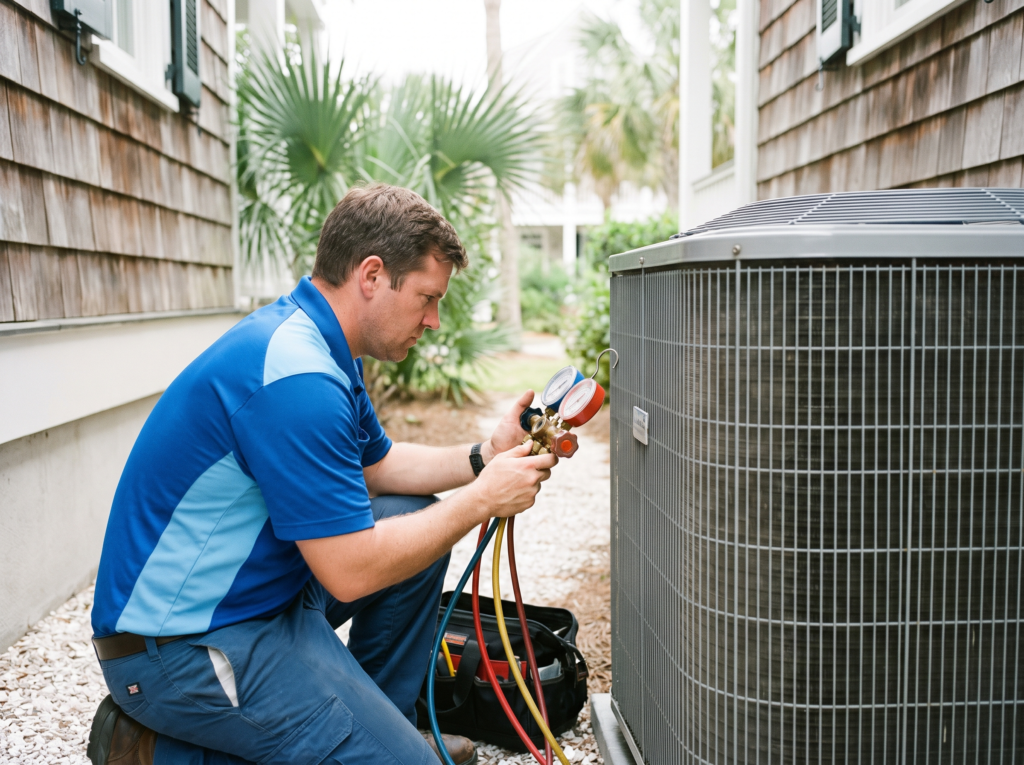
Oceanview technicians photograph what they find and give a firm price before any work starts, so you are approving a specific repair instead of a number on a clipboard. If you want to understand how a coastal system fails in the first place, the company’s article on salt air damage to Charleston air conditioners shows what a technician is actually looking at when the outdoor unit comes apart.
What a real diagnosis sounds like
- The technician names the failed part and shows it to you, in place, before removing anything.
- You see a photo of the corrosion, the burnt contact, or the blocked drain line, not just a code on an invoice.
- You hear what caused it, so the same failure is less likely to repeat next season.
- You get the price before the work, not after.
- If the honest answer is that the unit has another season in it, you hear that too.
Salt air, pine pollen, and humidity: why local experience changes the work
Equipment in the Lowcountry does not age the way equipment inland does, and a company that works here every day will tell you so without being asked.
What salt air does to an outdoor unit
Salt travels on the wind and settles on the aluminum fins and copper tubing of a condenser. Two things follow. Where two different metals touch in salty moisture, the more reactive metal gives up material faster than it would on its own; that is galvanic corrosion. Separately, salt breaks through the thin protective film on a metal surface and eats small holes into it, which is pitting corrosion. Pitting is the one that turns a coil into a slow refrigerant leak a year or two before anyone expected trouble.
That is why lifespan expectations shift with the address. Inland systems often reach 12 to 15 years. On the barrier islands — Folly, Sullivan’s, Isle of Palms, Kiawah — equipment often lasts 8 to 12. Neither range is a promise, and a company that quotes one flat number for every house is not paying attention to where the house is. There is more on that in the company’s guide to how long heating and cooling equipment lasts in salt air.
Pollen inland, humidity everywhere
Inland the problem is different. Spring pine pollen in Summerville, Ladson, and Goose Creek coats filters and coils with a yellow film that chokes airflow. The symptom looks like a failing system; the fix is not the same, and a technician who has cleaned a thousand pollen-packed coils knows which one you have.
Then there is the Lowcountry’s own complaint: a house that reads 74 degrees on the thermostat and still feels damp. Usually that is a system too large for the house, cooling the air so quickly that it shuts off before it has pulled much moisture out. The honest answer is rarely a bigger unit. The company’s article on why a house feels clammy with the AC running walks through what a technician checks first.
Two things you can safely do before you call: change the filter, and check the thermostat settings and batteries. You can reset a tripped breaker once, and you can rinse the outdoor coil gently with a garden hose on a low setting. What you should never do is open an electrical panel or touch refrigerant lines. If you smell burning, if the breaker trips more than once, or if you hear an electrical hum, shut the system off at the thermostat and the breaker and call for service.
What an honest quote looks like, and what it leaves out
A quote is a document, not a conversation. Ask for it in writing, and read it for three things: what is being replaced, what the price covers, and what happens if the repair does not hold.
On a replacement, the number that matters most is not on the price line. It is the sizing. A right-sized system comes from a load calculation that accounts for square footage, insulation, windows, and ductwork — the method the Air Conditioning Contractors of America publishes as Manual J. Matching the tonnage of the old unit is the shortcut that produces the clammy houses described above.
Read the warranty section twice. Most equipment carries a manufacturer parts warranty that only applies if the system is registered after installation, and labor coverage is usually separate and shorter. Ask who registers the equipment, how long labor is covered, and what voids either one. A company that answers plainly is telling you how it expects the next five years to go.
Oceanview offers a free second-opinion estimate to homeowners in the service area who have been told they need a new system, and arranges financing through third-party lenders, subject to approved credit. Current offers vary, so ask what is available the week you buy; the terms are on the page covering financing through third-party lenders.
Repair or replace, without the pressure
Replacement is a large unplanned expense, and the moment a homeowner hears the word is the moment a bad company starts selling. Here is what the decision actually turns on.
- Age measured against the problem. A ten-year-old island system with a leaking coil is a different conversation from a six-year-old inland system with a failed capacitor.
- Repeat failures. One repair is a repair. The third call in two summers is a pattern.
- Refrigerant type. Older systems run refrigerants that are no longer produced, which makes a leak repair costlier and less durable as supply tightens.
- Comfort, not just temperature. If the house has never felt right, replacing the same size with the same size will not change that.
- Ductwork. Leaky ducts in a hot attic waste a share of whatever a new system produces, so the ducts belong in the same conversation.
If you are weighing equipment types at the same time, the company’s guide to choosing between a heat pump and a furnace in the Lowcountry covers how the two behave in a climate with mild winters and long, humid summers.
Red flags worth slowing down for
None of these mean a company is dishonest. All of them mean you should ask another question before you sign anything.
- A replacement quote written before anyone measured the house or looked at the ducts.
- A price that drops sharply the moment you hesitate. A number that flexible was never firm.
- Refusal to put the diagnosis in writing, or an invoice that only says “system repair.”
- Scare language about your family’s safety attached to a sales close rather than to a specific, documented finding.
- No license number, no proof of insurance, or a street address that turns out to be a mailbox.
- A promise so absolute it cannot be kept, such as same-day arrival in every circumstance regardless of the schedule.
You are allowed to pause. A company that respects your home will wait a day for your answer; Oceanview’s free second-opinion estimate exists precisely because second opinions are reasonable.
Certifications, training, and who shows up in your driveway
The license is the floor. Training is the part you feel.
Two credentials are worth asking about by name. North American Technician Excellence, usually shortened to NATE, is a nationally recognized certification earned by passing knowledge tests rather than by sitting through a class. And anyone who opens a refrigerant circuit is required by the U.S. Environmental Protection Agency to hold a Section 608 certification. Both are industry-wide, and any reputable company can answer the question.
Harder to find is training for this particular coast. Oceanview trains its technicians on coastal corrosion, inland pine pollen, and the humidity problems that leave a cold house feeling clammy. The team includes a technician who works in Spanish and English. You can see who you are letting into your home on the meet the team page.
The day-of details matter more than most homeowners expect: a real arrival window instead of “sometime Tuesday,” a text when the technician is on the way, shoe covers at the door, and a tidy site when the work is done. Those habits are a decent proxy for how a company treats the parts of the job you cannot see.
Reviews, guarantees, and the fine print on specials
Read the recent reviews, not just the rating. Any company with hundreds of reviews has a bad week in there somewhere; what you are looking for is how they answered it. Oceanview has hundreds of five-star Google reviews, and you can read through them on the customer reviews page.
Ask what the guarantee actually promises. Oceanview backs its work with a 100% satisfaction guarantee. Then read any promotion with the same eye you would give any offer: current specials include $50 off an HVAC repair for new customers, one per household, on residential systems within the service area; a $49 seasonal tune-up (conditions apply; call for details); and the free second-opinion estimate. Conditions and dates live on the current special offers page.
Maintenance plans: what to look for before you sign
A maintenance plan is worth what it prevents. Near the water that is worth more than it is inland, because what you are really buying is a second set of eyes on a coil that corrodes whether anyone looks at it or not.
A tune-up should include more than a filter swap: a coil cleaning, a drain line check before it backs up into a hallway ceiling, electrical connections tightened, refrigerant pressures read, and the outdoor unit inspected for the pitting described earlier. Ask what is on the checklist before you compare plans.
Oceanview’s Harbor Club memberships start at $249 a year, or $21 a month, for the Coastal tier, with the Oasis tier at $399 a year, or $33 a month, and an Oceanside tier above it. Each includes two tune-ups a year, priority scheduling, no overtime charges, and a discount on repairs. Compare any plan on those four points — visits, priority, overtime, discount — before you compare the sticker price. The tiers are laid out on the Harbor Club membership page.
How to choose a heating and air company in Charleston: the short checklist
If you remember nothing else from this guide, take these ten questions to whoever you call next.
- Confirm the South Carolina license and current insurance, by number.
- Find out whether calls go to a local office or a national desk.
- Ask whether the technician diagnoses before quoting, and whether you get photos.
- Ask for the price in writing before the work begins.
- On a replacement, ask for a load calculation, not a tonnage match to the old unit.
- Ask what coastal and humidity training the technicians have had.
- Read the most recent reviews along with the company’s replies.
- Read the guarantee, and read the conditions attached to any special.
- Get a second opinion before you sign a replacement contract.
- Notice whether you were given an arrival window and a heads-up when the van is on the way.
Where Oceanview Heating and Air works, and what happens when you call
Oceanview is based in Summerville and works across Greater Charleston: Charleston, Mount Pleasant, North Charleston, Goose Creek, West Ashley, James Island, Johns Island, Daniel Island, Hanahan, Ladson, Moncks Corner, and the barrier islands. There are service area pages for 17 Lowcountry communities, from Summerville to the sea.
Call or text (843) 609-5740 and you get a real arrival window, a text when the technician is on the way, and same-day repairs in most cases. If your heat has not run since last winter, the companion guide to Charleston heating and air through a Lowcountry winter covers the pre-season check worth doing before the first cold night. When you are ready, schedule a visit with the Summerville office.
Choosing well is not complicated. It is just specific. Ask the license question, the diagnosis question, and the sizing question, and most of the guesswork falls away. Feel-good service is a shore thing, and it starts with a company that tells you what it found before it tells you what it costs.
Frequently asked questions
What are the best HVAC companies in Charleston, SC?
There is no official ranking, and the directory lists that show up in search are mostly paid placements or crowd-sourced opinions. A better test is verifiable: a current South Carolina license, proof of insurance, a diagnosis documented with photos before any quote, and reviews you can read in full rather than a number in an ad. Oceanview Heating and Air has hundreds of five-star Google reviews and is licensed and insured in South Carolina.
What is the average cost to replace an HVAC system in Charleston, SC?
Oceanview does not publish an average, because an average is not a quote. Price depends on the size the house actually needs, the equipment type, the condition of the ductwork, and the access at the site. The honest version is a load calculation and a written price after someone has looked at your home. If you have already been given a replacement quote, the free second-opinion estimate is there for exactly that situation.
Should I get a second opinion before replacing my system?
Yes, especially if the recommendation came during an emergency call on a hot day. A second opinion takes one visit and can confirm the diagnosis, catch a repairable fault, or change the recommended size. Oceanview offers a free second-opinion estimate for homeowners in the service area who have been told they need a new system.
Does Oceanview Heating and Air offer same-day repairs?
Same-day repairs happen in most cases, and the vans are stocked so the majority of repairs finish on the first visit. Scheduling still depends on the day and how far out the call is. If there is no heat or cooling, tell the office if someone in the home is elderly, an infant or unwell.