Ask most people in the Lowcountry what heats their house and they will say the furnace. Then in January the power bill arrives and it is double what they expected, and nobody can explain why.
There is a good chance you do not have a furnace at all. Around here, most homes heat with a heat pump, and a heat pump behaves so differently from a furnace that half the things people think are broken are actually normal, and one very common habit will quietly cost you a fortune. Five minutes and no tools will tell you which one you have.
Nearly every Lowcountry home heats with a heat pump
A heat pump is an air conditioner that can run backwards, moving heat into the house in winter instead of out of it. Here we need cooling most of the year and hard freezes are brief, so one piece of equipment doing both jobs is the efficient choice. Natural gas service is also patchy across the tri-county, so plenty of neighborhoods were built all-electric from the start.
The word furnace just stuck, the way people say Coke for any soda. It is harmless until you are trying to describe a problem on the phone.
Three tests that settle it in five minutes
1. Does the outdoor unit run when you are heating?
This is the definitive one. On a cold day, turn the heat on and walk outside to the big metal box beside the house. If the fan is spinning and the unit is humming while the house is calling for heat, you have a heat pump.
The outdoor unit is the air conditioner and it has no reason to run in January. If it sits dead silent while warm air comes out of your vents, you have a furnace.
2. Is there a gas line and a flue?
Go look at the indoor unit, in the closet, attic, garage or crawlspace. A furnace burns something, so it needs fuel in and exhaust out. Look for a black iron gas pipe running into the cabinet with a shutoff valve, and a metal vent pipe or plastic PVC pipe leaving the cabinet and heading up through the roof or out a wall.
Gas line plus flue means furnace. An indoor unit with nothing but ducts, a condensate line and electrical conduit going into it means a heat pump or an electric air handler.
3. Does the thermostat say EM HEAT or AUX?
If the mode options include EM HEAT or Emergency Heat, or if the display ever shows AUX or AUX HEAT when the heat is running, you have a heat pump. Those settings exist only on heat pump systems. A furnace thermostat has heat, cool, off and a fan switch.
If the three tests disagree, you may have a dual fuel or hybrid system — a heat pump paired with a gas furnace that switches between them as the outdoor temperature drops.
Why it is worth knowing
Two reasons, and both cost money.
The first is diagnosis. Telling us the outdoor unit runs in winter, or that the thermostat has an EM HEAT setting, changes what we bring and what we check — heat pump repair and furnace repair are genuinely different work.
The second is operating cost, and it is the bigger one. How you run a heat pump makes a much larger difference to your bill than how you run a furnace.
Auxiliary heat, emergency heat, and the mistake that spikes January bills
A heat pump moves existing heat rather than creating it, which is why it is efficient. When it is genuinely cold outside there is less heat available to move, and the heat pump alone may not keep up. So the system has a backup: electric resistance heating elements, usually called strips, sitting in the air handler. They work exactly like a giant toaster.
Strip heat is effective and instant. It is also, by a wide margin, the most expensive way to heat a house, because it makes heat directly from electricity rather than moving it.
The strips come on two ways, and the difference matters enormously.
- AUX means the system brought the strips in automatically to help the heat pump on a cold morning, then shut them off once it caught up. That is the system working as designed, and seeing AUX on a cold morning is fine.
- EM HEAT means you told it to shut the heat pump off entirely and run on strips alone. That setting exists for when the heat pump is broken or the outdoor unit is iced solid — a temporary measure so the house stays warm until a technician arrives.
The mistake
The house feels a little cool. Somebody sees Emergency Heat on the thermostat, thinks it sounds like the strong setting, and flips it. The house warms up right away, which seems to confirm it was the right move. And then it stays there. For weeks.
That is the single most expensive thing you can do with a heat pump, and it is behind a large share of the January bills we hear about. You have switched off the efficient part of your system and are running a giant toaster around the clock.
Go look at your thermostat right now. If it says EM HEAT or Emergency Heat and your outdoor unit is not actually broken, put it back on HEAT.
Things that look broken and are not
The air coming out feels cool
Hold your hand over a supply vent while a heat pump is heating and the air often feels lukewarm, even faintly cool. People assume something is wrong. Usually nothing is.
A furnace produces a short blast of genuinely hot air. A heat pump produces a long, gentle stream of warm air, and that air is typically below your body temperature. Your hand is warmer than the air, so the air registers as cool — while still being warmer than the room. Judge it by whether the house reaches and holds the temperature you set, not by how it feels on your skin.
Steam, ice and a loud whoosh outside
In heating, the outdoor coil gets cold enough to collect frost, which chokes airflow. So the system periodically runs a defrost cycle: it briefly reverses, sending hot refrigerant out to melt the ice off.
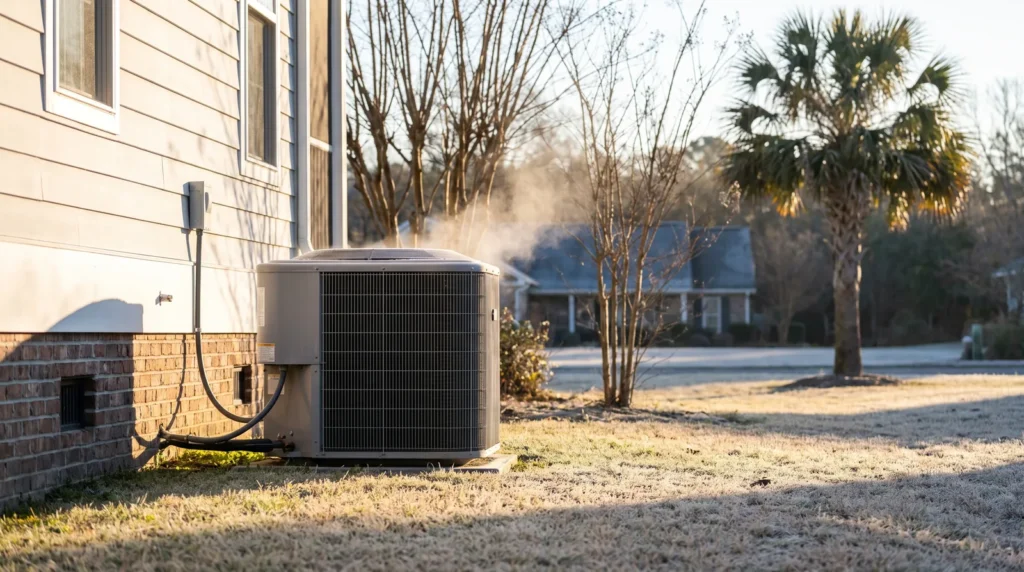
From the yard this looks alarming. The outdoor fan stops, there is a loud whoosh or clunk as the reversing valve shifts, ice is visible on the coil, and steam pours off the unit. All of that is normal, it lasts a few minutes, and it happens more on damp Lowcountry cold snaps.
Big thermostat setbacks work against you
With a furnace, dropping the thermostat ten degrees overnight and pushing it back up in the morning saves money. With a heat pump, it often does not.
A heat pump heats gently and steadily. Ask it to make up a large gap quickly and the thermostat concludes it is falling behind and brings the strips on to catch up — so your savings overnight get spent on expensive backup heat in the morning. Modest setbacks of a couple of degrees are fine. Large ones usually backfire.
This is where a properly configured smart thermostat earns its keep. A thermostat set up for heat pump operation recovers gradually and starts early enough that the strips never need to be called. The key word is configured — default settings or incorrect heat pump wiring can make it worse.
When it genuinely is a fault
Normal covers a lot, but not everything. Call somebody if you see:
- AUX or EM HEAT showing constantly, including on mild days
- The outdoor unit staying encased in ice, or never completing a defrost
- The house never reaching setpoint no matter how long it runs
- The outdoor unit silent in heating mode while the indoor blower runs
- A breaker that keeps tripping — stop resetting it, that is an electrical fault
Most of these are ordinary heat pump repairs if caught early: a failed defrost board or sensor, a stuck reversing valve, a low charge, a bad contactor. Left alone through a cold snap on strip heat, they get expensive twice over — once on the repair and once on the bill.
The cheapest version of all this is having the system checked before the first cold snap, not during it. That is what heating maintenance is for.
Still not sure what you have?
Send us a photo of your thermostat and your indoor unit and we can usually tell you over the phone. If you do need work, you will get a firm price before anything starts, and nobody is angling to turn a repair into a replacement that you do not need.
Call or text 843-609-5740, answered any hour of any day, or reach us online. We cover Summerville, Charleston, Mount Pleasant and the surrounding Lowcountry.