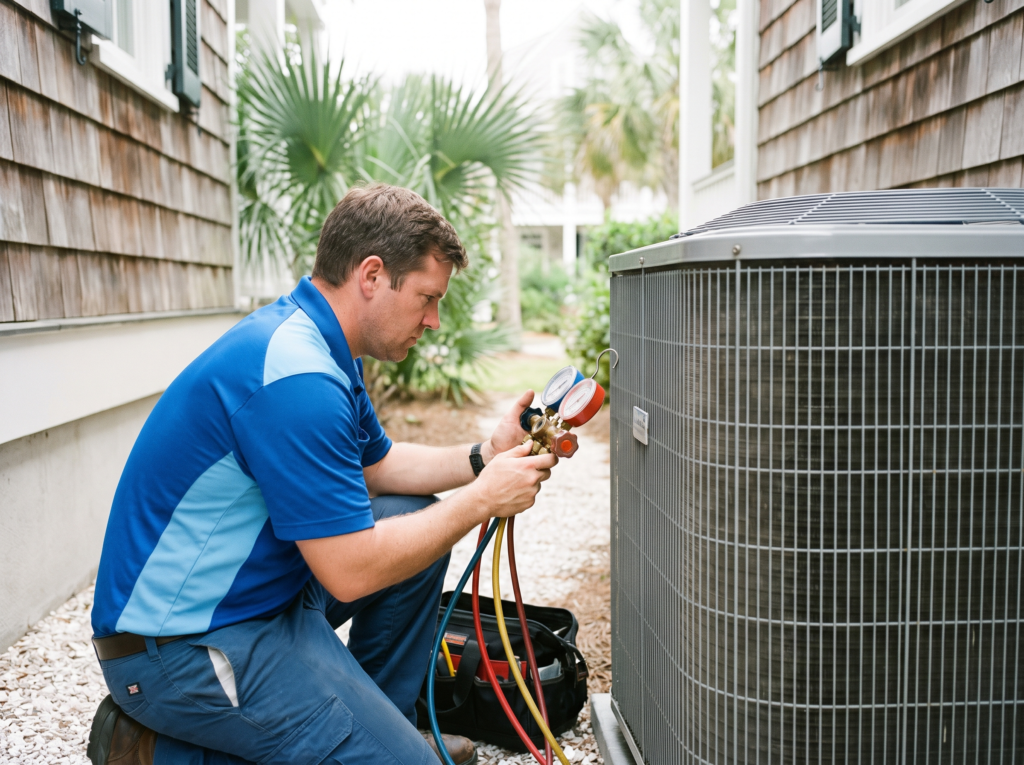

Every October the same question comes into our Summerville office: should I cover my outdoor unit before winter? For almost every home in the Lowcountry, the honest answer is no. The outdoor cabinet was built to sit out in weather, and near the coast a tarp or a vinyl wrap usually causes more harm than it prevents, because it traps salty moisture against metal that needs to dry. If you heat with a heat pump, covering it is worse than pointless. That cabinet is the part making your heat.
Should I Cover My Outdoor Unit? The Short Answer for Coastal Homes
No full cover, and no trash bag or tarp. A wrap turns the cabinet into a damp box: condensation forms inside, rain still blows in at the bottom, and none of it dries. Mice and palmetto bugs find a dark, sheltered space and move in for the season. The coil, the fan and the cabinet are finished for outdoor use, and they hold up better with air moving through them.
There is one narrow exception. If a unit sits under a limb that drops branches, a piece of plywood weighted down on top keeps falling debris off the fan. The top only, the sides open, and it comes off before the system runs again. That is protection from something falling, not from winter.
If You Heat With a Heat Pump, That Cabinet Works All Winter
Most homes around Charleston heat with a heat pump rather than a furnace. A heat pump does not burn fuel. In winter it runs the refrigeration cycle backward: the outdoor coil pulls heat out of the cold outside air and the indoor unit releases it into the house. Even on a 35-degree morning there is heat in the air to move.
So the outdoor unit is not resting in January. It is the machine making your heat, and it needs free airflow across that coil. Cover it and you starve the one part doing the work. You may also see it steam or frost over and then clear itself, which is the defrost cycle doing its job. And if the air from your vents feels cool rather than hot, a cover is not the cause either; we explain why a heat pump blows air that feels cool separately.
Why a Cover Is a Worse Idea Near Salt Water
Salt spray rides the wind well past the beach. From Folly Beach and Sullivan’s Island to houses along the Ashley and the Wando, outdoor equipment picks up a film of chloride that ordinary rain rinses off and a cover holds in place.
Two kinds of corrosion do the damage. Pitting corrosion is chloride eating small holes straight through the aluminum fins and their coating. Galvanic corrosion happens where two different metals meet, copper tubing against an aluminum fin for instance, and salty water sitting in that joint acts like a weak battery, so one metal gives itself up to the other. Both need the same thing to keep going: moisture that stays put. A cover is very good at keeping moisture in place.
That is why coastal equipment wears out sooner. Inland systems often reach 12 to 15 years; on the barrier islands, often 8 to 12. There is more in our article on what salt air does to an air conditioner in Charleston.
The One Winter Chore Worth Doing: A Gentle Rinse
Rinsing the outdoor coil is the rare job we are glad to hand to a homeowner. Turn the system off at the thermostat first. Then take a garden hose at normal pressure, never a pressure washer, and rinse the coil from the outside in, top to bottom, until the water runs clear. Plain water is the point: you are washing salt off, not scrubbing.
Leave the rest to a technician. Do not take panels off, do not straighten fins with a brush or a screwdriver, and do not touch refrigerant lines or wiring. Within a few miles of the water, a rinse every couple of months does more for that unit than any cover ever will.
What Actually Protects an Outdoor Unit Through a Lowcountry Winter
A few small habits do the work a cover cannot:
- Keep about two feet of clear space around the cabinet, and trim shrubs back so nothing leans on it.
- Rake out the leaves, pine straw and grass clippings that pile up against the base.
- Do not stack patio furniture, storage bins or a kayak on top of the unit for the season.
- Change the indoor filter on schedule; a clogged filter makes the outdoor unit work harder in heating mode just as it does in cooling.
- Book the pre-season check before the first cold night, not after it.
That last one matters most in a heat pump market, because nothing tests a system like the first run of the season. A heating maintenance visit covers the reversing valve, the defrost control, the backup heat strips and the amp draw on the compressor, the parts that are only asked to work when the weather turns. Our Lowcountry guide to heating maintenance in Charleston walks through what that first cold snap asks of a coastal system.
When to Shut the System Off and Call
Some things are not homeowner jobs. Shut the system off at the thermostat and call us if you smell anything burning, if the breaker trips again after you have reset it once, or if you hear an electrical hum or buzz at the outdoor unit or the air handler. Do not keep resetting a breaker, and do not open a panel to look.
If there is an older adult, a young child or someone unwell in the house and the heat is out, say so when you call. Those calls move up the schedule.
Before the First Cold Night
Oceanview Heating and Air works out of 126 Farm Road in Summerville and covers Greater Charleston, from Moncks Corner to the barrier islands. We diagnose before we quote, show you photographs of what we found, and give you a firm price before the work starts. Repairs finish the same day in most cases, because the vans are stocked for it.
If you would rather not keep track of scheduling it twice a year, a Harbor Club membership includes two tune-ups a year, priority scheduling and no overtime charges. Our current specials list a $49 seasonal tune-up for residential homes in our service area, with each offer’s conditions on the page. When you are ready, call or text the Summerville office at (843) 609-5740 and we will give you a real arrival window.
Frequently asked questions
Does an outdoor AC unit need to be covered in winter?
No. The cabinet, coil and fan are finished for outdoor use and do better with air moving through them. A full cover holds damp, salty air against the metal and gives pests a dry place to nest for the season. If leaves or limbs land on the unit, clearing them off does more good than wrapping it.
How do you winterize an outdoor AC unit on the coast?
There is not much to it. Turn the system off at the thermostat, rinse the coil with a garden hose at normal pressure until the water runs clear, clear leaves and pine straw away from the base, and leave about two feet of open space around the cabinet. Panels, wiring and refrigerant lines are a technician’s job. If you heat with a heat pump, the unit is not shutting down for the season at all.
What outside temperature is too cold for an outdoor unit?
Heat pumps are made to run in cold weather, and Lowcountry winters stay well inside what they handle. As the temperature drops into the thirties, many systems start leaning on backup heat strips, which is normal rather than a fault. The limit that matters here is cooling mode: systems often carry a low-temperature cutoff around 60 degrees, so on a mild winter afternoon use the heat setting rather than the air conditioning.
What is the best way to cover an outdoor air conditioner if I want to?
Cover the top only. A weighted piece of plywood or a lid-style cover keeps falling debris off the fan while the sides stay open to breathe. Never wrap the whole cabinet in plastic or vinyl, and take any cover off before the system runs again. On a heat pump, that means leaving it off through the winter, because the unit runs to make your heat.
Will a cover keep salt air off my unit?
It tends to do the opposite. Salt arrives as airborne spray and settles on the coil; a cover keeps rain from rinsing it away and holds damp air inside the cabinet, which is exactly what feeds pitting and galvanic corrosion. A gentle hose rinse every couple of months does far more for a coastal system than any cover.