
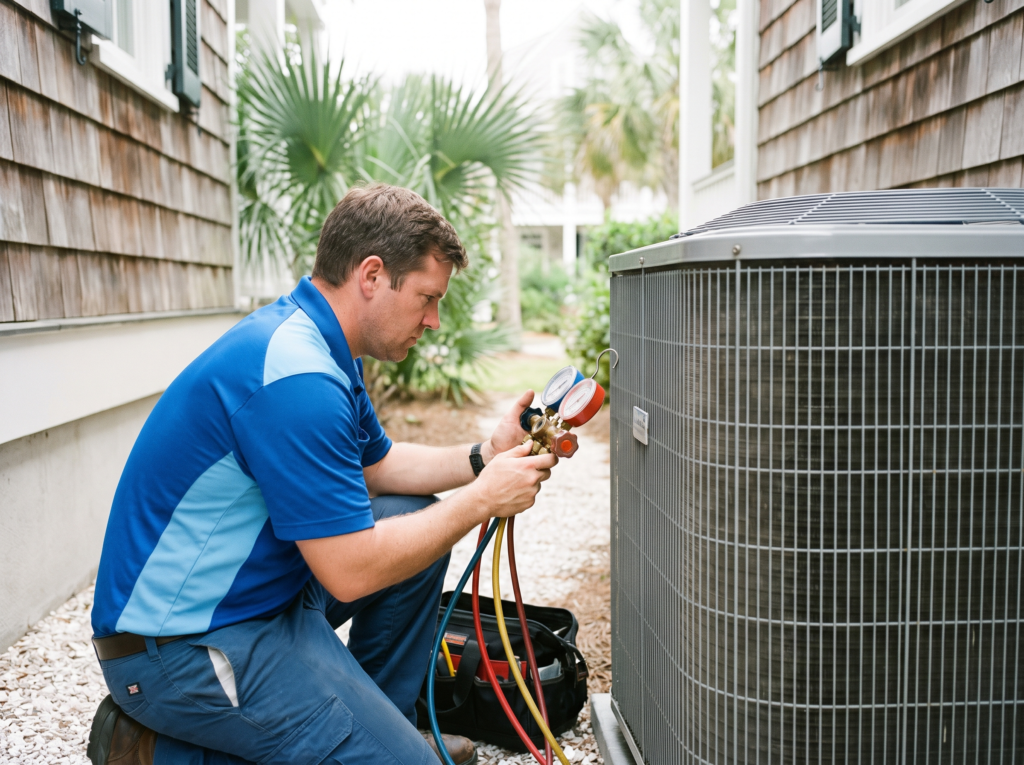
A Charleston heating and air system spends most of the year cooling, so the first cold night is the real test. In the Lowcountry that usually means a short cold snap rather than a long freeze: your heat needs to start cleanly, run quietly, and warm the house without a surprise on the power bill. This guide from Oceanview Heating and Air covers what is normal, what you can safely check yourself, and when to shut the system off and call.
What a Charleston heating and air system is doing on a cold night
Most homes across Greater Charleston heat with a heat pump. A heat pump is the same outdoor unit that cools the house in July, running in the other direction. Instead of pulling heat out of your living room and dumping it outside, it pulls heat out of the outdoor air and moves it inside. A part called the reversing valve makes that switch, which is why the outdoor unit runs on a cold December night at all.
Because a heat pump moves heat instead of burning fuel to make it, it suits a climate like ours, where a cold night usually means the 30s rather than weeks below freezing. It also behaves differently from a furnace. The air coming out of the vent is warm, but it is often cooler than your hand, which is why many homeowners assume the heat is not working. Long, steady run times at a gentler temperature are how a heat pump is designed to work.
Some Lowcountry homes do have a gas furnace, and some have a dual-fuel setup that leans on the furnace when it gets cold enough. If you are not certain which one is in your house, our comparison of a heat pump or a furnace in the Lowcountry walks through how each one behaves and what each costs to run.
What is normal on the first cold night, and what is not
Heat that has sat idle since March will do a few things that sound alarming and are not. It will also do a few things that mean stop. Knowing which is which saves you a worried evening, and it keeps you from shrugging off the one that matters.
Normal
- A warm, dusty smell for the first ten to sixty minutes, as dust burns off the heat strips or the furnace heat exchanger. It should fade and not come back.
- Long run cycles. A heat pump warms a house slowly and steadily rather than in short bursts.
- Air at the vent that feels lukewarm against your skin instead of hot.
- Steam rising off the outdoor unit while the outdoor fan sits still for a few minutes. That is a defrost cycle melting frost off the outdoor coil. Steam drifts and disappears; smoke does not.
- A whoosh or a clunk as the system moves into and out of defrost.
- Auxiliary or backup heat showing on the thermostat on a genuinely cold morning.
Stop and call
- A burning smell that keeps going, or that smells like hot plastic, rubber or wiring rather than dust.
- A breaker that trips again after you have reset it once.
- Buzzing, humming or crackling from the electrical panel, the indoor air handler or the outdoor unit.
- Scorch marks, melted insulation, or a wire that looks darkened.
- A carbon monoxide alarm sounding in a home with a gas furnace or a gas water heater.
- No heat at all when someone in the house is elderly, very young or unwell.
The burning-dust smell is the most common first-night worry. Our article on what that first-run smell means and when to shut it off goes through it in more detail, including the smells that are not dust.
Shut it off and call: the rule worth remembering
If you smell burning that does not fade, if the breaker trips a second time, or if you hear an electrical hum or buzz, turn the system off at the thermostat, leave the breaker off, and call a licensed technician. Do not open an equipment panel, do not reset a breaker over and over, and never try to handle refrigerant, wiring or a sealed component yourself. The parts behind those symptoms carry line voltage even when the thermostat says the system is off.
If a carbon monoxide alarm sounds, get everyone outside first, then call 911 and your gas utility. Carbon monoxide is colorless and has no smell, so the alarm is the only warning you get. Working alarms on every level of the house matter more in heating season than at any other time of year.
When you are ready to talk to someone, call or text the Summerville office at (843) 609-5740. Calls reach our own office on Farm Road rather than a national call center, and we handle same-day repairs in most cases. If the heat is out, tell the office if someone in the home is elderly, an infant or unwell.
Safe checks you can make before you call
A fair number of first-cold-night calls end with something simple. These are the checks any homeowner can make without opening equipment.
The thermostat
Confirm it is set to Heat, not Cool or Off, and that the target temperature is above the room temperature. Check the fan setting too: on Auto, the blower runs only while the system is heating. If the screen is blank or dim, change the batteries. If the thermostat was swapped out since last winter, it may not be set up for heat pump staging, which is a common reason backup heat runs far more than it should.
The filter
A filter that has been in place since spring pollen season is choking airflow. Starved airflow makes a heat pump underperform and can trip a furnace safety switch. Replace it, write the size down off the frame, and set a reminder for every one to three months depending on pets and dust.
The outdoor unit
Pine straw, leaves and grass clippings pile against the coil through the fall. Clear a couple of feet around the unit and lift anything resting on top of it. Do not cover a heat pump for the winter; it runs year round, and a cover traps moisture against metal. If you live near the water, a gentle rinse with a garden hose, with the system off at the thermostat, washes salt off the coil. Never use a pressure washer, and never use a cleaner you have not checked against the manufacturer instructions.
Vents and returns
Furniture moved for the holidays, a rug over a floor register, or a guest room closed off all change how the system balances. Open the supply registers and keep the return grille clear.
The breaker, once
Look at the panel. If a breaker is tripped, reset it one time. If it trips again, leave it off and call. A breaker that keeps tripping is doing its job and telling you something past it is wrong.
If the system still will not heat, a heat pump repair visit starts with a diagnosis and photographs of what the technician found, and you get a firm price before any work begins.
What a pre-season heating check finds
A heating check in October or early November costs less than a repair in January, and it is the single best way to avoid the no-heat call. A thorough visit generally covers:
- Electrical connections tightened and inspected for corrosion. Loose or corroded connections are a leading cause of a dead system the morning after the first cold snap.
- The reversing valve and defrost control tested, so the system really does switch into heating and clear frost when it should.
- Refrigerant charge measured. A heat pump running low quietly leans on expensive backup heat instead of failing outright, so you pay for it on the power bill before you notice it.
- Electric heat strips and their sequencers checked under load.
- On a gas furnace, the burners, flame sensor, heat exchanger and flue inspected.
- Blower wheel, filter and airflow checked.
- The condensate drain cleared, since a heat pump sheds water during defrost as well as in summer.
- Thermostat staging verified so backup heat does not come on earlier than it needs to.
You can book that as a one-time heating maintenance visit, or as part of a membership that covers two tune-ups a year. Either way, ask for the findings in writing, with photographs.
Why salt air changes the math on the coast
A technician in Moncks Corner and a technician on Sullivan’s Island are not looking at the same equipment, even when it is the same model bought the same week. Salt-laden air works its way into an outdoor unit and attacks it in two ways worth knowing by name.
Galvanic corrosion happens when two different metals touch while salty moisture sits on them. The moisture behaves like the fluid inside a battery, and the weaker of the two metals gives up material to the other. A condenser coil, where aluminum fins meet copper tubing, is a textbook setting for it.
Pitting corrosion is more local. Salt breaks through a protective coating in tiny spots, and the damage drills downward instead of spreading out. A cabinet or a coil can look sound from three feet away and still have pinholes through it.
In heating season that shows up as parts failing under load: a contactor whose pitted surface will not carry current, a fan motor that seizes on a cold morning, a coil that gives up refrigerant after years of thinning. We cover the outdoor side of this in what salt air does to an outdoor unit in Charleston.
It also changes how long equipment lasts. Inland, a well-maintained system often reaches 12 to 15 years. Out on the barrier islands, from Folly Beach to Isle of Palms and Kiawah, 8 to 12 years is often closer to what we see. If you want the longer version, read how long heating and cooling equipment lasts in salt air.
Auxiliary heat, and the bill that follows
When the outdoor temperature drops far enough, or when you ask for a big jump in indoor temperature all at once, a heat pump turns on auxiliary heat. On most Lowcountry systems that means a bank of electric resistance heat strips, which make heat the expensive way rather than moving it the cheap way. An hour on the strips costs several times an hour on the heat pump alone.
Two habits call for them more often than the weather does. The first is setting the thermostat way back overnight and then asking for a ten-degree recovery at six in the morning. The second is pressing Emergency Heat because the house feels slow to warm. Emergency Heat locks the heat pump out entirely and runs on strips alone. It is meant for a system that is broken, not for a system that is working steadily.
Smaller setbacks, three or four degrees instead of ten, usually keep you off the strips. A thermostat set up correctly for heat pump staging helps as well, and our page on smart thermostats covers the settings that matter. For the noises and the costs that come with backup heat, see why auxiliary heat sounds and costs different.
A warm house that still feels damp
Winter here is not reliably dry. A 60-degree rainy week leaves plenty of moisture in the air, and a heat pump running short, mild cycles does not pull much of it out. The result is a house that reads 70 degrees on the thermostat and still feels clammy, with fogged windows in the morning and a musty smell in the closet on the exterior wall.
Heating the air harder is the wrong lever. The real fix is usually some combination of sealing ductwork and the crawl space, right-sizing equipment so it runs long enough to do its job, and in many coastal homes adding a whole-home dehumidifier that controls moisture independently of temperature. We walk through the winter version of this problem in winter humidity in a coastal home.
Repair or replace, and how to get an honest answer
The hardest conversation of the season is the one where a technician says the system is finished. That is a large, unplanned expense, and it deserves more than one opinion. We diagnose before we quote, show you photographs of what we found, and hand you a firm price before work starts, so you can compare one quote against another on the same terms.
A few questions sort most of it out. How old is the equipment, and where does that sit in the range for your part of the Lowcountry? Is the failed part a compressor, a coil or a heat exchanger, or is it a contactor or a capacitor? Is anything still covered by the manufacturer warranty? Has the system needed repairs two seasons running? If someone has already told you that you need a new system, our free second-opinion estimate exists for exactly that moment.
When replacement really is the right answer, financing through third-party lenders is available, subject to approved credit, and current offers vary, so ask what is on the table the week you are buying. If you are weighing Charleston heating and air companies rather than equipment, our guide to choosing a heating and air company in Greater Charleston lists the questions worth asking.
Getting ready before the first cold night
Three things carry most Lowcountry homes through the season: a fresh filter, a pre-season check on the calendar before Thanksgiving, and a clear plan for the night something smells or sounds wrong. That last one is the shortest plan you will ever make. Shut it off and call.
If you would rather not keep track of the scheduling, the Harbor Club maintenance membership starts at $249 a year, or $21 a month, for the Coastal tier, with the Oasis tier at $399 a year, or $33 a month, and an Oceanside tier above that. Membership covers two tune-ups a year, priority scheduling, no overtime charges and a discount on repairs. Current specials include $50 off any HVAC repair for new customers, one per household, residential, within our service area, and a $49 seasonal tune-up (conditions apply; call for details); each offer carries its own conditions, which are listed with our current specials.
Oceanview Heating and Air works out of 126 Farm Road, Suite A in Summerville, and is licensed and insured in South Carolina. We cover Greater Charleston from Summerville to the sea, with service-area pages for 17 Lowcountry communities, and our team includes a technician who speaks Spanish and English. Every visit is backed by our 100% satisfaction guarantee. Call or text (843) 609-5740 before the forecast gets interesting, and we will look at your heat while it is still a scheduling question instead of an emergency.
Frequently asked questions
What is the five-thousand-dollar rule for HVAC?
It is a rule of thumb, not a rule. You multiply the age of the equipment in years by the cost of the proposed repair, and if the result climbs past five thousand dollars, replacement is usually the better value. It is a rough sorting tool, and it ignores things that matter on the coast, such as whether the failed part is a compressor or a capacitor and how much life salt air has already taken out of the cabinet. Use it to start the conversation, not to finish it.
What heating and air brands should I stay away from?
Brand matters less than most people expect. Nearly every major manufacturer builds equipment that performs well when it is sized correctly, installed correctly and maintained, and the same equipment disappoints when it is not. The bigger questions are whether the system was sized for your house, whether the ductwork can carry the airflow, and whether parts and warranty support are easy to get locally. Ask about those before you ask about the badge on the cabinet.
Why does one room stay colder than the rest of the house in winter?
Usually it is airflow rather than the equipment. A long or crushed duct run, a blocked register, a room with no return path when the door is shut, or thin insulation over a bonus room all leave one space behind while the hallway thermostat reads just fine. A technician can measure the airflow at that register and compare it with what the room needs, which tells you whether the answer is duct work, balancing or insulation.
How do I pick a good heating and air contractor in Charleston?
Look for a South Carolina license and proof of insurance, a diagnosis before a quote rather than a price guessed over the phone, a written firm price before work starts, and photographs of whatever the technician found. Ask whether the company works on coastal equipment regularly, since salt air changes what fails and how soon. Asking for a second opinion on a replacement quote is normal, and a good contractor will not take it personally.