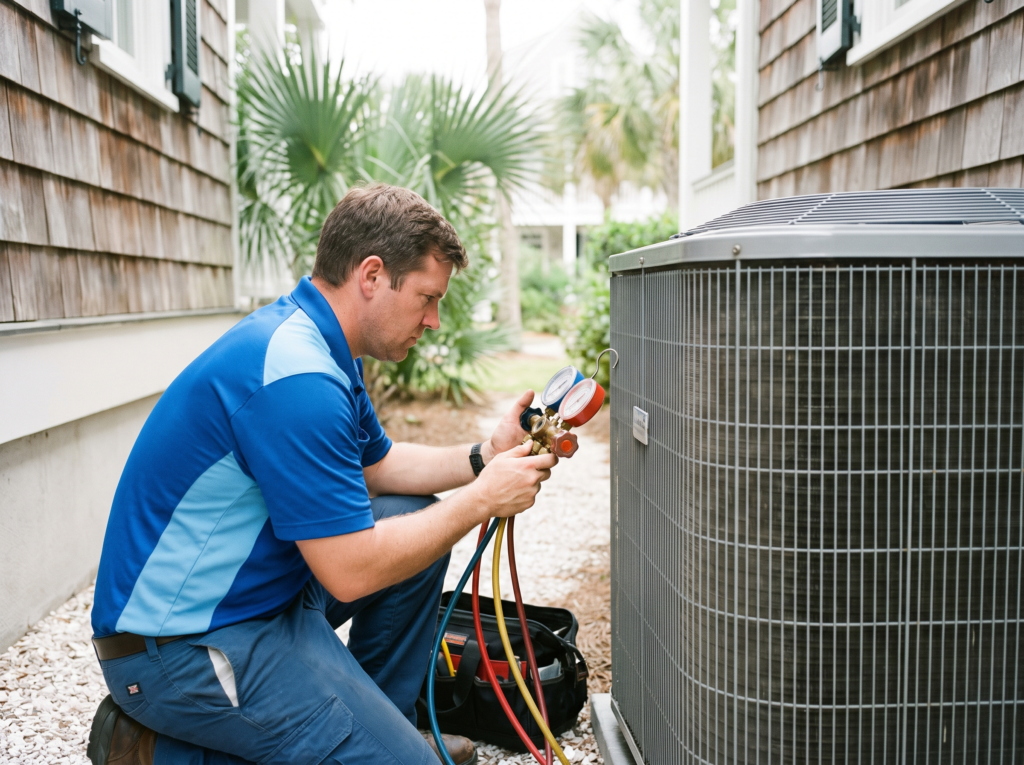
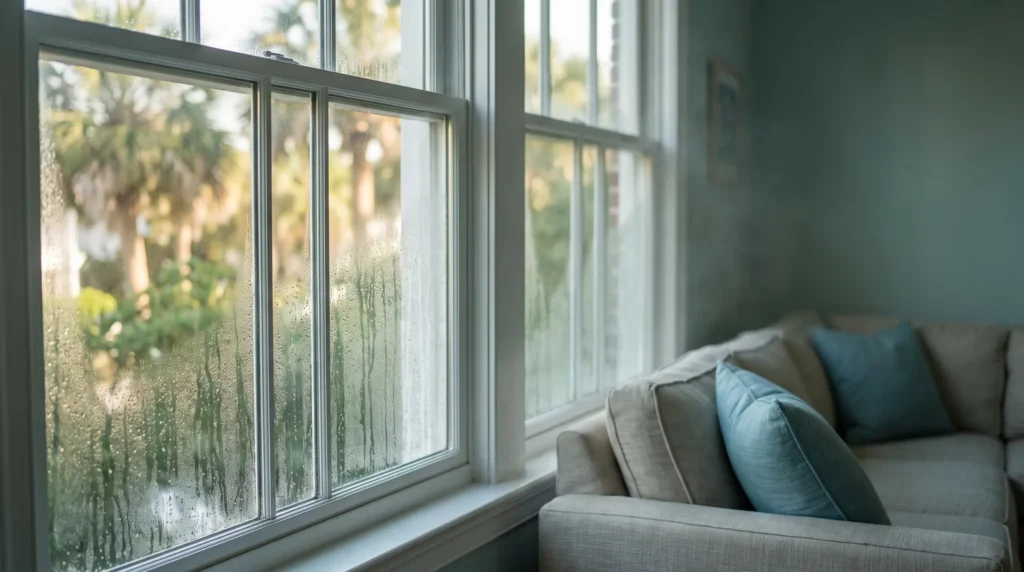
The thermostat reads 73°F. The air conditioner is running. And the house still feels like the inside of a cooler that has been shut too long. Towels never quite dry on the rail. The sheets feel faintly damp when you get into bed. There is a smell in the hall closet that was not there in February.
You are not imagining it and you are not being fussy. What you are feeling is moisture, not temperature, and those are two separate problems. An air conditioner is very good at the first and only accidentally good at the second. Here is what is actually happening inside your house, how to find out for certain in about a week, and what fixes it in order of what it costs you.
Your air conditioner only dries the air while it is running
Dehumidification is a side effect of cooling, not a separate function. Warm humid air passes over a cold evaporator coil, water condenses on that coil the same way it beads on a glass of sweet tea, and it drains away outside.
Which means the moisture only leaves your house during the minutes the system is actually running. The coil needs time to get properly cold and stay cold before it pulls meaningful water out of the air. Short runs cool the air and leave the water in it.
Why the mild days are the worst days
People expect to feel clammy in August. They are surprised to feel clammy in April.
Picture a typical Lowcountry shoulder-season afternoon: 76°F outside with 85% relative humidity, gray and wet. Your house barely needs cooling. The thermostat is satisfied almost immediately, so the system runs a few minutes an hour, if that. Meanwhile moisture is still pushing into the house through doors, windows, the crawlspace and the walls themselves, and nothing is taking it back out.
That is why the worst clammy days of the year here are usually not the hottest ones. They are the mild wet ones in spring and fall when the equipment has almost nothing to do.
The usual culprit is a system that is too big
When a house feels damp, the instinct is to assume the air conditioner is too weak. Nine times out of ten around here, the opposite is true.
An oversized system blasts the house down to setpoint in a few minutes and shuts off. Then it comes back on, blasts, shuts off again. That pattern is called short-cycling, and it is the single most common reason a Charleston house feels cool and clammy at the same time. The thermostat is happy. Your skin is not.
The ten-minute test
You do not need any tools for this one. On a warm afternoon, when the system kicks on, look at a clock. Note the time it starts and the time it stops.
Do that four or five times across a couple of days. If your system is repeatedly running less than about ten minutes before shutting off, on a day when it ought to be working, that is a red flag worth acting on. Long, steady runs are what you want, not short bursts.
Short cycling can also be caused by faults rather than sizing: a low refrigerant charge, a dirty coil, a restricted filter, a thermostat mounted in a bad spot. Those are worth ruling out with a proper diagnostic visit before you conclude the equipment is simply the wrong size.
Why bigger was never better
Oversizing usually happens at replacement time, when somebody rounds up to be safe, or in a new build where the same equipment package gets dropped into every floor plan in the neighborhood. It is why brand-new houses in Nexton, Cane Bay and Carolina Park can feel muggier inside than a hundred-year-old house downtown.
A correctly sized system is not the smallest one that works. It is the one that runs long and steady on a design day. That is why a proper load calculation matters more than tonnage guesswork when you are looking at a new system.
What your indoor humidity should actually be
Aim for roughly 45% to 55% relative humidity indoors. That is the band where a house feels crisp rather than heavy, and where your floors and doors stay where you left them.
Above about 60%, held for weeks at a time, is where things start going wrong. That is the range where mold and mildew get what they need on closet walls and behind furniture on exterior walls, where dust mites and the allergens they produce thrive, where the musty smell settles in, and where hardwood floors start cupping at the board edges and cabinet doors stop closing square.
Buy a hygrometer before you buy anything else
The fastest way to stop guessing is a small digital hygrometer. They cost less than a takeout dinner. Put one in the main living area and one in the worst-feeling room — usually a back bedroom or a room over a crawlspace — and read them for a week, morning and evening.
Now you have numbers instead of opinions. If you are sitting at 65% while the thermostat says 73°F, you have your answer.
The other things quietly adding moisture
- A leaking return duct. This is the big one and it hides well. If the return side of your duct system has gaps where it runs through a crawlspace or attic, the blower pulls hot wet unconditioned air straight into the system and distributes it through the house. You are effectively air conditioning the crawlspace. Sealing return leaks often produces the single biggest drop in indoor humidity for the money.
- Exhaust fans that are missing, broken or never used. A shower puts a surprising amount of water into the air. So does a pot of boiling water. If the bath fan does not run for a good while after the shower, or the range hood recirculates instead of venting outside, that moisture stays in the house.
- Vented crawlspaces. Common under older homes in West Ashley, James Island and downtown. Humid outdoor air enters, hits cooler surfaces, and dumps its moisture underneath your floor. It then works its way up.
Turning the thermostat down makes it worse
This is the instinct everybody has, and it backfires.
Dropping the setpoint from 73°F to 69°F does not remove more moisture. It chills the surfaces in your house — walls, floors, furniture, the inside of closets — while the air stays humid. Cold damp surfaces are exactly what condensation and mildew want. You end up colder, wetter, paying more, and no more comfortable.
Fix the moisture and the opposite happens. Dry air lets sweat evaporate off your skin, which is how your body actually cools itself. Most households that get humidity under control find they can sit at a higher temperature than before and feel better doing it.
The fixes, cheapest first
- Set the fan to AUTO, not ON. With the fan on ON, the blower keeps running after the compressor stops and blows air back over a wet coil, re-evaporating the water you just paid to remove and sending it right back into your rooms. AUTO is correct in this climate almost all of the time.
- Get the basics right. A clean filter, a clear condensate drain and a coil that is not caked in dirt all affect how well the system dehumidifies. That is ordinary AC maintenance, which matters more here than the manual implies given we run cooling most of the year.
- Seal the return leaks. Moderate cost, often dramatic result, especially in homes over crawlspaces.
- Move to variable-speed or staged equipment when you replace. A variable-speed system runs long and slow at low capacity instead of blasting and stopping. Long runs are what dry a house out. Paired with a properly configured smart thermostat that can hold a humidity target, it behaves completely differently from a single-stage unit.
- Install a whole-home dehumidifier. This is the definitive answer. A whole-home dehumidifier ties into your ductwork, runs off its own humidistat, and works when the air conditioner is idle — which, as we covered, is precisely when you need it. It drains continuously, so there is no bucket to empty and forget about.
If your house is cool and still clammy
Start with the hygrometer and the ten-minute test this week. Between those two, you will know whether you have a moisture problem, a run-time problem, or both, and you will be able to say so in plain numbers.
If you want it measured properly, we will read humidity room by room, check the ducts and crawlspace, and tell you honestly whether the answer is a setting, a repair or a piece of equipment. Call or text 843-609-5740 any hour of any day, or book a visit online. We cover Summerville, Charleston, Mount Pleasant and the rest of the Lowcountry.