Air duct cleaning is worth doing in a Charleston home when there is visible debris in the ducts, evidence of mold growth, a rodent or insect problem, or dust still blowing out of registers after a renovation. It is not worth doing on a routine schedule, it will not fix a dust problem caused by a leaky return, and it will not lower your power bill. The honest version is that most Lowcountry houses need their ducts cleaned once or twice in a few decades, and need their ducts sealed far more often than that.
Duct cleaning gets sold aggressively around here, often with a low teaser price and a photograph of somebody else’s ducts. So here is the plain version: what it does, when it helps, and what to look at instead.
What duct cleaning actually is
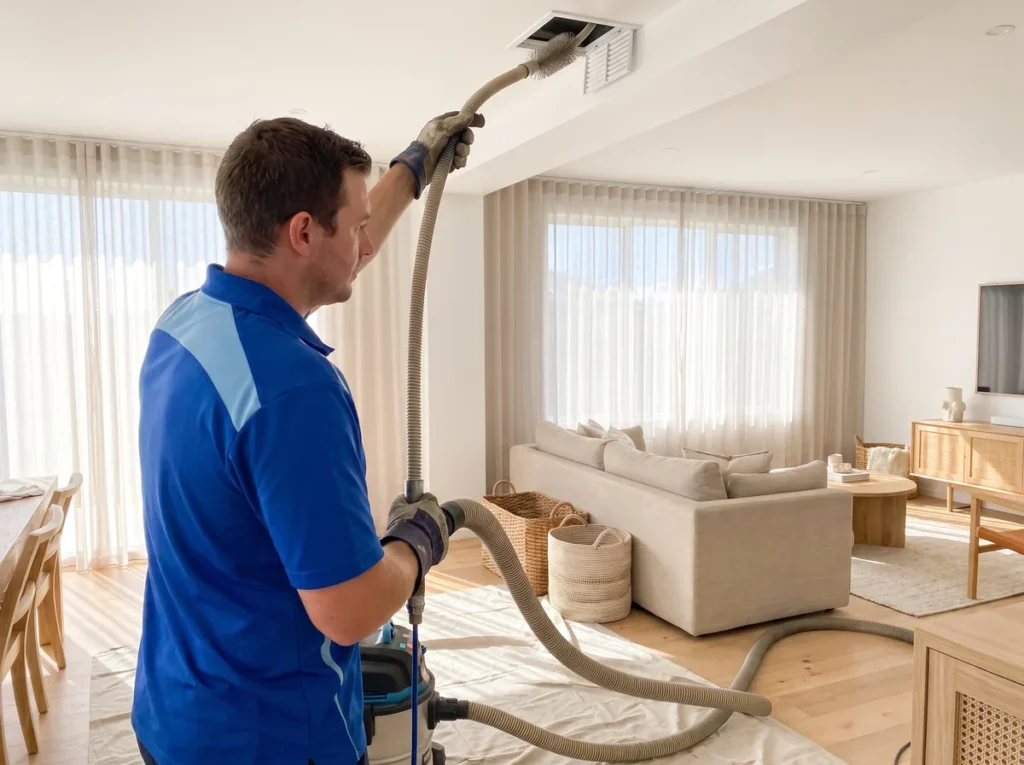
Done properly, a technician puts the duct system under negative pressure with a large vacuum, then works mechanically through each branch — rotating brushes or compressed-air whips — to dislodge what is stuck to the inside of the duct wall and pull it out. Supply trunk, return trunk, every branch run, the registers, the grilles, the blower compartment and the coil.
That last part matters more than people realise. If a crew cleans the ducts but never opens the air handler to look at the blower wheel and the evaporator coil, they have cleaned the pipes and ignored the place where the dirt actually accumulates.
What it is not
It is not somebody holding a shop vac at a register for ninety seconds. If a quote is remarkably cheap and covers unlimited vents, that is what you are buying. The business model is the upsell once they are in your attic.
The five situations where it genuinely helps
- You can see debris. Pull a register cover off and look in with a flashlight. If there is a visible layer of fuzz, grit or construction dust, or you can see it blowing out when the system starts, that is a real finding.
- There has been water in the system. A condensate overflow, a roof leak over an attic duct, a crawlspace that flooded, a storm that pushed water in. Wet fibreglass duct liner and wet flex duct grow mold, and in our humidity they grow it fast. This is the strongest single reason to clean, and sometimes the honest answer is replacement rather than cleaning.
- Animals got in. Rodents, squirrels in the attic, roaches. Nesting material and droppings in a duct is a health matter, not an aesthetic one.
- You just finished a renovation. Drywall dust is extremely fine and it gets everywhere. If the system ran during demolition or sanding, the ducts are full of it, and you will keep breathing it for years otherwise.
- You bought the house and have no idea. A one-off clean at the start of ownership, paired with an inspection of the whole duct system, is reasonable money for a baseline. Especially on the older housing stock in West Ashley, North Charleston and downtown, where the ducts may well predate you by forty years.
The situations where it will not help
If none of the five above apply, cleaning the ducts is unlikely to change anything you can measure. Specifically, it will not fix these:
- A dusty house caused by return leaks. If the return side of your duct system has gaps where it passes through the crawlspace or attic, the blower is pulling in unfiltered air from those spaces — dust, insulation fibres, crawlspace damp — and distributing it. Clean those ducts and they will be dirty again in a season, because the source never stopped. The fix is sealing the ductwork.
- High humidity and a musty smell. If your house sits above 60% relative humidity for weeks at a time, you have a moisture problem that cleaning will not touch. A whole-home dehumidifier addresses the cause.
- Your energy bill. There is no credible evidence that cleaning ducts in a normally dusty home reduces consumption. Sealing them does. Those are different jobs.
- Allergies, by itself. Better filtration and humidity control do far more for allergy symptoms than a one-off clean. A proper filter cabinet and air purification deal with what is circulating now, continuously.
Why Charleston ducts get dirty faster than most
Three local factors stack up:
Humidity. Dust in a dry duct sits there. Dust in a damp duct becomes something that grows. Our dew point sits above 70°F for much of the year, and ductwork in a vented crawlspace lives in that air.
Where we put ducts. Almost nobody here has ducts inside conditioned space. They run through vented crawlspaces under raised houses on James Island and downtown, or through attics that hit 130°F in July in Summerville and Goose Creek. Both are dirty, humid, pest-accessible environments.
Pollen and construction. Spring oak and pine pollen is heavy enough to coat cars, and large parts of Berkeley and Dorchester County have had active construction nearby for years. Both end up inside.
What a proper job looks like
If you do have a reason to clean, this is the standard to hold a contractor to:
- They inspect and show you the inside of the ducts first, in your house, not a stock photo.
- They put the system under negative pressure with a vacuum vented outside, not into your living room.
- They agitate mechanically in every branch — brushes or air whips — rather than just vacuuming at the register.
- They open the air handler and clean the blower wheel and the evaporator coil.
- They seal access holes properly when they are done.
- They check for and report leaks, crushed flex runs and disconnected boots while they are in there, because that is the inspection that actually saves you money.
- They do not spray a sanitiser or sealant into your ducts as a default. Those have limited evidence behind them and we would rather not put chemicals into your supply air to cover a problem that should be removed.
Our own air duct cleaning work follows that order, and if we open your ducts and find they do not need it, we will tell you that and charge you for the inspection rather than the clean.
How we quote it
We will not post a price, because a single-system ranch in Ladson and a two-system house with 40 registers and a crawlspace in Mount Pleasant are not the same job, and a flat number would be wrong for one of them. What you get is a written itemized quote after we have looked, covering the cleaning and anything we found that needs sealing or replacing, with the costs separated so you can choose.
Where to start
Take a register cover off this weekend and look inside with a flashlight. That five-minute check answers the question for most houses. If you see debris, water staining, or anything that looks like growth, get it inspected. If it looks clean and your complaint is dust, humidity or allergies, your money is better spent on sealing, filtration and humidity control.
Either way, we will come and look and tell you which it is. Call or text 843-609-5740 or book an inspection online. We serve Charleston, Summerville, Mount Pleasant, North Charleston and the surrounding Lowcountry.