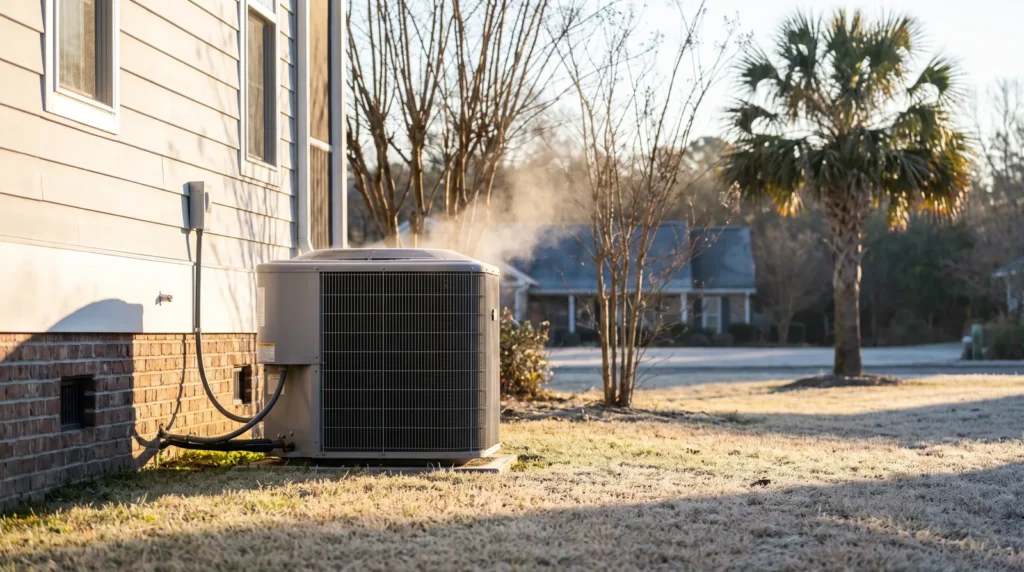
A heat pump that frosts over, puffs out a cloud of steam and clunks loudly on a cold morning is almost always doing exactly what it was built to do. That is the defrost cycle: the system briefly reverses itself to melt ice off the outdoor coil, then switches back to heating. A normal defrost lasts a few minutes and happens occasionally. You have a problem when it runs constantly, when the unit stays encased in ice, or when it never comes out of defrost at all.
Because almost every house in the Lowcountry heats with a heat pump rather than a furnace, this is one of the things we get asked about most between November and February. Here is what is happening and where the line sits.
Why the coil frosts in the first place
In heating mode, your outdoor coil is the cold one. It has to be colder than the outdoor air in order to pull heat out of it, which means on a 38°F morning that coil might be sitting near 25°F.
Any moisture in the air that touches it freezes. And our air has a great deal of moisture in it. That combination — temperatures in the 30s and 40s with high humidity, fog off the marsh, dew that does not burn off until mid-morning — is the single best frost-making condition there is.
This is why Charleston heat pumps defrost more often than the same model would in Denver, where it gets far colder but the air is dry. Frequent defrost here is not a defect. It is the climate.
What a normal defrost cycle looks and sounds like
You will usually notice four things in sequence:
- A loud clunk or whoosh. That is the reversing valve shifting. It is a solenoid-driven valve redirecting refrigerant, and it is not subtle. People describe it as a thump under the house or somebody dropping a toolbox.
- The outdoor fan stops. The compressor keeps running but the fan goes quiet, which is the opposite of what you expect and makes people think the unit has failed.
- Steam. Sometimes a lot of it, rolling off the top of the unit. That is melted frost evaporating off a hot coil, not smoke. On a still morning it can look alarming.
- Cool air from the vents. The system is running cooling outdoors, which means it is running cooling indoors too. Most equipment energises the backup heat strips during defrost to offset that, but you may still feel it.
Then another clunk, the fan restarts, and you are back in heating. Start to finish, somewhere between about two and ten minutes.
How often is too often
Older systems defrost on a timer — typically every 30, 60 or 90 minutes of compressor run time, whether the coil needs it or not. Newer systems use demand defrost, reading coil temperature and only defrosting when there is actually ice to melt. Demand defrost is better and cycles less.
On a cold damp Lowcountry morning, a defrost every 30 to 90 minutes of run time is reasonable. Every fifteen minutes, all day, is not.
The signs that something is actually wrong
Here is where to stop watching and start calling:
- The unit is a solid block of ice. Light frost on the fins is fine. Ice filling the coil, covering the fan blades or building up on top of the cabinet means defrost is not working. Keep running it in that state and you risk bending fan blades and stressing the compressor.
- It never leaves defrost. If the outdoor fan is off and the vents are blowing cool air for half an hour, the defrost board or its termination sensor has likely failed.
- Ice on the ground around the unit. Melt water is supposed to drain away. If it is pooling and refreezing, the pad has settled, the drain holes are blocked with leaves and pine straw, or the unit is sitting too low. In our rainy season that happens easily.
- The clunk became a bang, or disappeared. A reversing valve that bangs hard, chatters or has gone silent while frost keeps building is usually the valve or its solenoid coil.
- Short defrosts that do not clear the ice. Often a low refrigerant charge. Which means a leak, which on the coast often means corrosion.
- The breaker trips during defrost. Defrost pulls the most current of any moment in the system’s operation, including the backup heat strips. A marginal connection or a weak contactor shows itself right there.
Salt air makes this worse here than almost anywhere
Everything about defrost depends on a coil that can shed heat and shed water. On Sullivan’s Island, Isle of Palms, Folly Beach and the marsh-front streets of Mount Pleasant and James Island, salt aerosol corrodes aluminum fins and eats the coating off copper. A corroded coil holds water, drains badly and transfers heat poorly, so it frosts sooner and clears slower.
Rinsing the outdoor unit with fresh water on a regular schedule genuinely helps, and it is the one piece of heat pump maintenance a homeowner can do safely. Hose it gently, from the outside in, with the power off at the disconnect. Do not pressure wash it — the fins bend at almost nothing.
What you can do yourself before the first cold snap
- Clear leaves, pine straw and mulch back from all four sides of the outdoor unit. It needs roughly two feet of clear air and nothing blocking the drain holes in the base pan.
- Cut back the shrubs somebody planted around it to hide it. Pittosporum and loropetalum do not care about airflow.
- Make sure the pad is level and has not sunk. Our soil moves.
- Take the cover off. People put covers on outdoor units in winter the way they would a patio grill. A heat pump runs in winter. Covering it is actively harmful.
- Change the filter and set the fan to AUTO.
What you should not do is chip ice off the coil with anything, or pour hot water over it. The fins are thin aluminum and the refrigerant lines are soft copper. People put holes in both every year trying to help.
Where a technician comes in
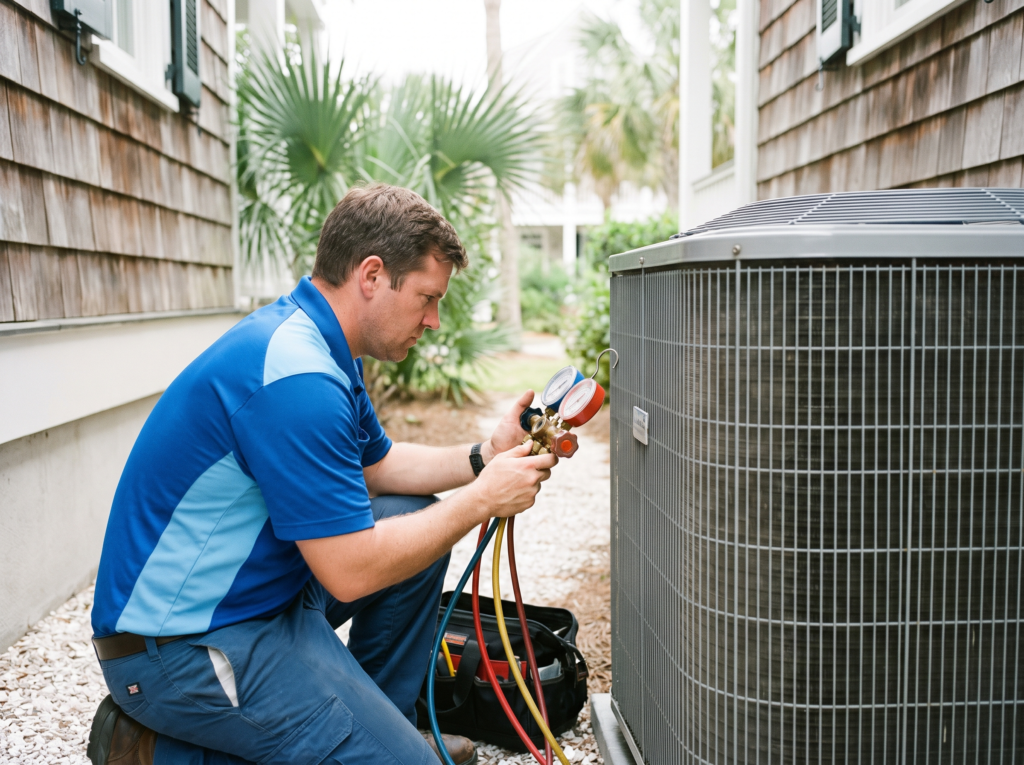
Defrost faults live in parts you cannot assess by looking: the defrost control board, the coil temperature sensor, the reversing valve solenoid, refrigerant charge, the condition of the backup heat sequencers. Those get checked with meters and gauges during a heating maintenance visit, and they are precisely the components that fail quietly in October and loudly in January.
If frost or ice is already building, that is a heat pump repair call rather than a maintenance one. If you would rather have the seasonal checks happen without having to remember them, the Harbor Club plan books both visits for you and puts you ahead of the queue when something does break.
The short version
Frost, steam, a clunk and a few minutes of cool air mean your heat pump is managing our damp winter mornings the way it was designed to. Ice that does not clear, defrost that never ends, or water pooling and refreezing under the unit mean it is not.
If you are not sure which one you are looking at, take a photo of the outdoor unit and call or text 843-609-5740, or book online. We are not a 24-hour emergency service — after hours you will reach our answering service — but we will find you the earliest appointment we have. We work across Mount Pleasant, Summerville, Charleston and the rest of the Lowcountry.