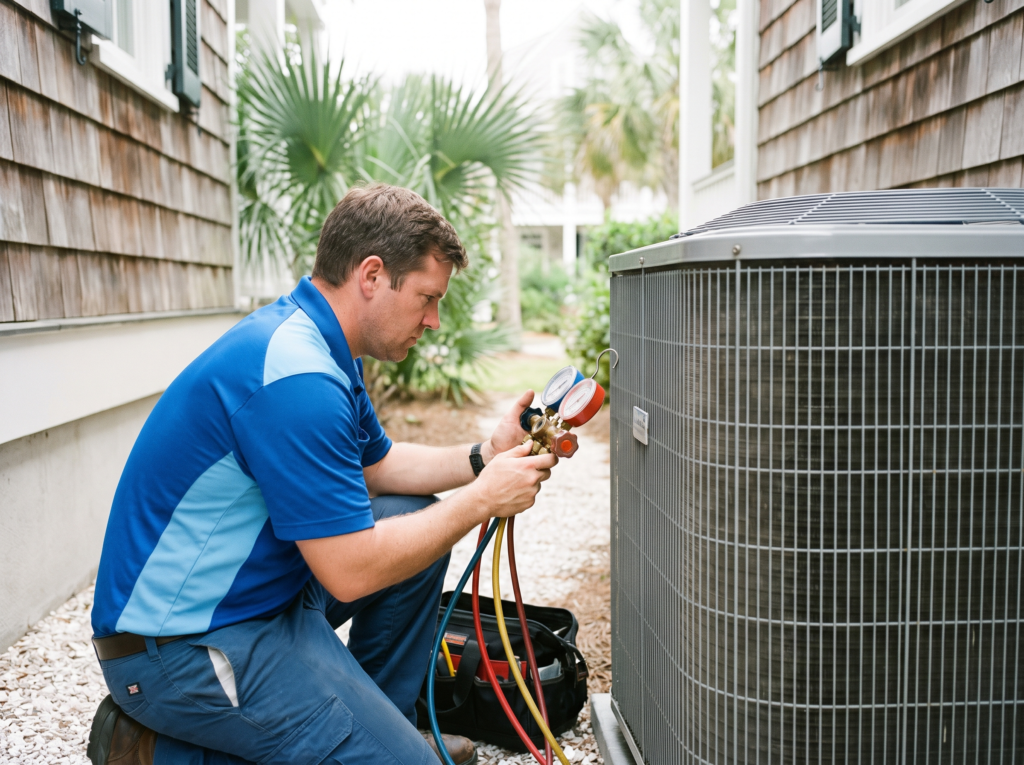

Anyone who quotes you an air conditioning repair over the phone, before seeing the system, is guessing — and the guess is usually low, because a low number gets the appointment. The price of a repair depends on which component failed, whether the refrigerant circuit has to be opened, what refrigerant the system uses, how accessible the equipment is, and whether the fault that caused the failure is still there. What you should expect from a contractor is a written, itemized quote after a diagnosis, with the repair figure and, on an older system, the replacement figure beside it.
That is not evasion. Here is exactly what drives the number, so you can judge a quote rather than just react to it.
Variable one: which part failed
This is most of the spread. Repairs fall into rough tiers:
- Consumable electrical parts. Capacitors, contactors, relays, sequencers, float switches. Small parts, short labour, no refrigerant work. The cheapest category by a wide margin, and also the most common.
- Motors. Condenser fan motors and blower motors. More part cost, more labour. An ECM variable-speed blower motor costs considerably more than an older PSC motor, and its control module can fail separately.
- Controls. Control boards, defrost boards, thermostats. Part-cost driven, usually quick labour.
- Drainage. Clearing a blocked condensate drain, replacing a pump, correcting a drain line that was never pitched properly.
- Refrigerant circuit work. Leak searching, coil replacement, line set repair, reversing valve replacement, compressor replacement. Recovery, brazing, evacuation and recharge all take real time, and this is where the expensive end lives.
A capacitor and a compressor are both “AC repair” and they are not remotely the same purchase.
Variable two: whether refrigerant is involved
Opening the sealed system changes a repair from an hour to most of a day. The refrigerant has to be recovered legally, the repair made, the system pulled into a deep vacuum to remove moisture and non-condensables, then weighed in with a fresh charge.
And the refrigerant itself matters:
- R-410A is current enough for repair purposes, though new equipment has already moved to lower-GWP refrigerants.
- R-22 has not been produced or imported since 2020. The only supply is reclaimed, and it is priced accordingly. A refrigerant repair on an R-22 system means paying scarcity prices for something you will not be able to buy at all in a few years. That does not mean replace a working R-22 system tomorrow, but it is a strong reason not to invest a large repair in one. Our piece on repairing versus replacing goes through that arithmetic.
One thing worth being firm about: refrigerant is not consumed. If your system is low, it has a leak. A contractor who tops it up without finding the leak is selling you the same repair again next summer, and that is a practice to decline.
Variable three: access
The same part costs different labour in different houses, and the Lowcountry has some of the worst access anywhere.
- An air handler in a crawlspace under a raised house downtown, reached on your stomach.
- An attic air handler in August, where the working temperature is well over 120°F and a technician can only work in short stretches.
- A condenser on a flat roof.
- Equipment in a closet built around it, where panels cannot come off without removing trim.
- Elevated units on a lift or platform on the islands.
None of that is padding. It is genuinely more time for the same repair.
Variable four: whether there is a second fault behind the first
Components usually fail for a reason. A capacitor that has failed twice in two years is telling you about a hard-starting compressor or high head pressure. A blower motor that burned out is often downstream of a filter nobody changed and static pressure that was too high for years. A compressor that failed on an overcharged system failed because of the overcharge.
A good diagnosis finds the cause, not just the dead part. That sometimes makes the quote larger than you hoped, and it is the difference between a repair that holds and one that comes back.
Variable five: parts availability and warranty
Most equipment carries a manufacturer parts warranty of five to ten years, often only if it was registered after installation. If yours is still in warranty, the part may be covered and you pay labour and refrigerant. Worth checking, and worth asking any contractor to check before they order.
On the other side, parts for discontinued or less common equipment can take days to source, and an OEM board for a ten-year-old proprietary system can cost more than a generic motor for a newer one.
Why we will not post a price list
We could put a number on this page. It would get more clicks and it would be wrong for most of the people who read it, because the only accurate way to price your repair is to find out what is wrong with your system.
What we do instead:
- Diagnose the fault properly, with instruments, and tell you what failed and why.
- Put the repair in writing, itemized — parts, labour, refrigerant, anything else — so you can see what each line is for.
- Where the system is old enough that replacement is a fair question, put that number in writing alongside it. Both figures, same page, so you can decide at your own kitchen table rather than under pressure in a hallway.
- Tell you if we think the repair is a poor investment, even though the repair is the smaller sale.
You can see what that AC repair process involves in more detail, and if the answer turns out to be a new system, the same rule applies: a load calculation first, then an itemized number.
How to read a repair quote
Things a quote should tell you:
- What component failed, named.
- Why it failed, if that is known.
- Parts and labour shown separately.
- Refrigerant quantity, if any, rather than “charge as needed.”
- What warranty covers the repair itself.
- What is not included.
Things that should make you pause: a single number with no breakdown; a replacement recommendation with no diagnosis of the actual fault; a refusal to quote the repair alongside the replacement; pressure to sign today; a refrigerant top-up with no leak search; a diagnostic fee that is not disclosed until the technician is in the attic.
The cheapest repair is the one you do not have
This is not a sales line, it is just what the failures look like. Most of the capacitors, motors and compressors we replace were measurably degrading for a season or more. Capacitance drifting below spec, amp draw climbing, a coil nobody had cleaned, a drain growing biofilm, a charge sitting slightly low.
A seasonal AC maintenance visit catches those while they are the cheap tier of repair rather than the expensive one, and in a climate where we run cooling for most of the year that matters more here than the equipment manual implies. The Harbor Club plan covers both seasonal visits and puts members ahead of the queue in the weeks when everybody calls at once.
Getting a real number
If something is wrong now, we will diagnose it and put the figures in writing. Call or text 843-609-5740 or book online. We are not a 24-hour emergency service — after-hours calls reach our answering service — but we will find you the earliest appointment we have. We cover James Island, Charleston, Summerville, Mount Pleasant and the rest of the Lowcountry. With 1000+ reviews behind us, we would rather tell you something inconvenient than sell you something you do not need.