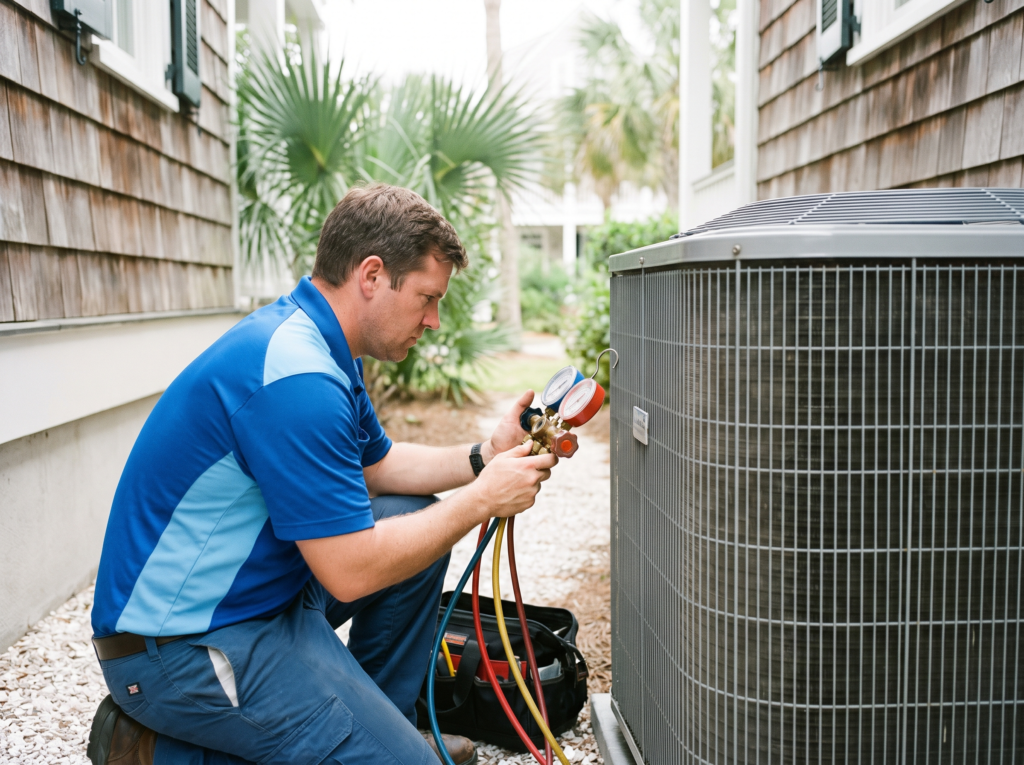

The short answer: repair a system under about ten years old unless the compressor or the coil has failed, and seriously consider replacing one over fifteen if the repair is a major component. Between those, the deciding factors are which part failed, what refrigerant it uses, how many hours it has actually run, and whether the rest of the system is in reasonable shape. Age alone is a poor reason to replace, and a single cheap repair is a poor reason to keep something that is going to fail again in March.
Here is how to work through it in a structured way, so the decision is yours and not a sales pitch.
Lowcountry systems age faster, and that matters
National guidance says 15 to 20 years for a system. That number is written for a climate with a real winter and a four-month cooling season. We run cooling for seven to eight months and heating for part of the rest, which means a Charleston system logs far more compressor hours per calendar year than the same equipment in Pennsylvania.
Add coastal salt exposure on anything within a few miles of the water and the practical expectation here is closer to 12 to 15 years, and 10 to 12 on the barrier islands. So a 14-year-old system in Mount Pleasant is not middle-aged. It is old.
Find the real age
Do not trust the previous owner’s recollection. Look at the data plate on the outdoor unit and find the serial number. Most manufacturers encode the month and year of manufacture in the first four digits. If you cannot read it, the technician on your next visit can.
Step one: which part failed
This is the biggest single input, and it splits cleanly.
Repair it
- Capacitor. A consumable part. Replace it and move on, at any age.
- Contactor, relay, sequencer. Same category.
- Condenser fan motor. A fair repair on anything up to around twelve years.
- Blower motor. Usually worth it, though on a very old air handler it is worth asking what else is tired.
- Thermostat, defrost board, control board. Repair.
- Condensate pump, float switch, drain line. Repair, and get the drain sorted properly while somebody is there.
- Duct faults. Always worth fixing regardless of equipment age, because the next system inherits the same ducts. A leaky, undersized or crushed duct system will make brand-new equipment perform badly, which is why we look at ductwork before we talk about equipment.
Think hard
- Compressor failure. The most expensive single component. On a system past about ten years, replacing a compressor often means putting the most costly part into a machine whose remaining parts are all the same age.
- Evaporator or condenser coil leak. Expensive, labour-heavy, and on the coast often a symptom of corrosion that is not limited to the one spot that failed.
- Reversing valve on a heat pump. Major refrigerant-circuit work.
- A cracked furnace heat exchanger. Not a judgement call. That is a combustion safety issue and the furnace comes out.
- Repeated refrigerant loss. If it has been topped up more than once, you are paying for the same leak annually.
Step two: check the refrigerant
If the data plate says R-22, that changes the arithmetic. R-22 has not been produced or imported since 2020, and the only supply is reclaimed. Any repair that opens the refrigerant circuit on an R-22 system means paying a scarcity price for a refrigerant you cannot buy in five years. Systems on R-410A are fine for repair purposes today, though the industry has already moved on to newer refrigerants for new equipment, so very old R-410A units are heading the same way eventually.
This is not a reason to panic-replace a working R-22 system. It is a strong reason not to invest a large repair in one.
Step three: the honest cost comparison
You will see rules of thumb online — multiply the repair cost by the system’s age and compare to replacement, or replace if the repair is more than a third of a new system. They are rough, and they are better than nothing.
What we would rather do is give you the actual numbers for your actual house. On any repair that is substantial enough to make this a real question, we put both figures in writing in front of you: what the repair costs, itemized, and what a replacement costs, itemized. Not an estimate shouted from the attic hatch. Both numbers, on paper, so you can take them to the kitchen table and decide.
Things that belong in that comparison and often get left out:
- What the rest of the system is likely to need in the next three years.
- Whether the ducts need work either way.
- Whether the existing system was correctly sized in the first place — a lot of Lowcountry systems are oversized, which is why so many houses here are cool and clammy at the same time.
- What financing looks like, because a replacement you can spread is a different decision from one you cannot.
Step four: the comfort problems you have been living with
This is the part that gets forgotten. If you are going to spend serious money either way, it is worth asking what the money buys beyond “it runs again.”
- Is the house humid even when it is cool? A properly sized variable-speed system runs long and slow, which is what actually dries a Lowcountry house out.
- Are there rooms that never get comfortable? That is usually ducts, sometimes zoning, occasionally a case for a ductless mini split on an addition or a bonus room over a garage.
- Is it loud? Older single-stage equipment is.
- Does the upstairs run five degrees warmer than the downstairs all summer?
A repair returns you to how it was. A replacement, done with a real load calculation rather than matching the old tonnage, is a chance to fix the comfort complaints you have stopped mentioning.
Signs it is time, even without a breakdown
- Two or more service calls in the last twelve months.
- Bills climbing year over year with no change in how you live.
- It runs almost continuously in July and still will not hold setpoint.
- The outdoor cabinet is visibly rusting through, which on the islands happens well before the mechanical parts give up.
- It is R-22 and something significant has just failed.
Signs you are being pushed
You are entitled to be sceptical. Reasonable warning signs: a replacement recommendation with no diagnosis of what failed; a refusal to quote the repair alongside it; pressure to sign today; a quote with one number on it and no itemization; a system sold on tonnage alone with no load calculation and no conversation about your ducts.
Ask for both numbers in writing. Ask what failed and why. Ask what size the load calculation says you need. Any honest contractor will answer all three without flinching.
The cheapest version of this decision
Most of the compressors and coils we condemn were failing measurably for a year or two first — low charge, high head pressure, a coil nobody had cleaned. Regular diagnostic attention and seasonal servicing is what turns a surprise replacement into a planned one, and a planned replacement is always cheaper and always a better system, because you chose it rather than taking what was on the truck in August.
If you want a straight read on what you have, we will diagnose it and give you both numbers in writing. Call or text 843-609-5740 or book a visit. We cover North Charleston, Summerville, Charleston, Mount Pleasant and the wider Lowcountry.