
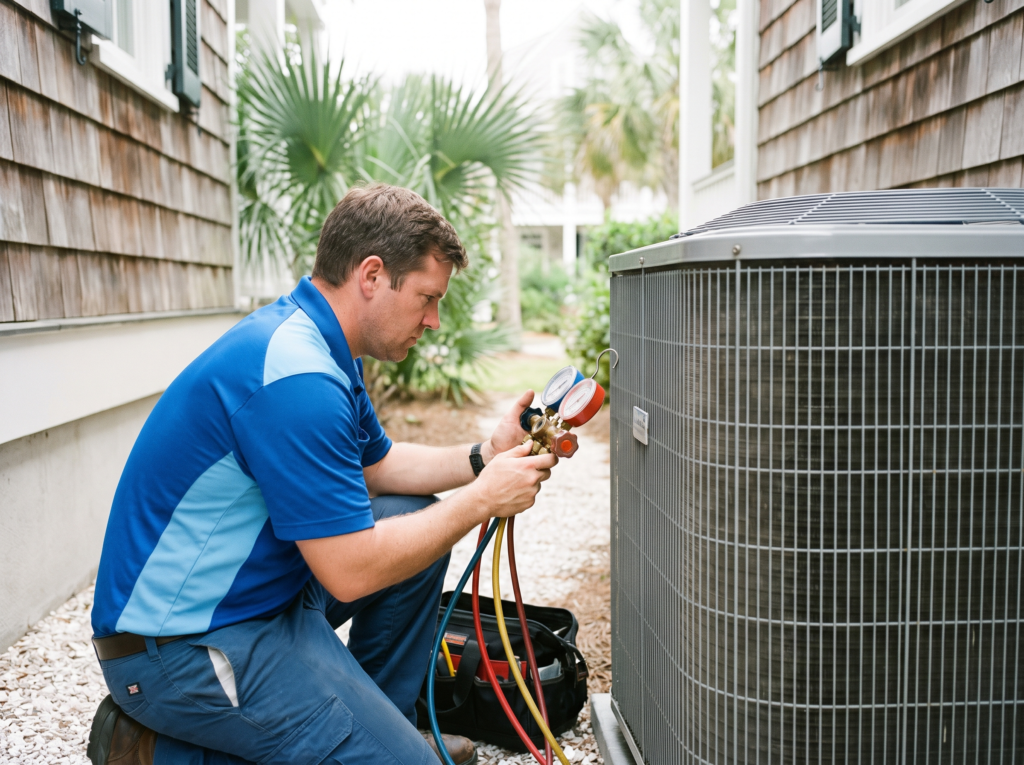
Why does my heat smell like burning the first time I turn it on? Nearly always, the answer is dust. After a long Lowcountry cooling season, fine dust settles on the burners or on the electric heat strips inside your indoor unit, and the first real heating cycle burns it off. That odor is dry and dusty, a little like a hot iron, and it fades as the system runs. What is not normal is melting plastic, hot rubber or a sharp electrical smell. Those mean shut the system off at the thermostat and call for service.
Why Your Heat Can Smell Like Burning Dust After a Long Cooling Season
In Greater Charleston, the cooling side of the system does most of the year’s work. Plenty of homes run air conditioning from March into October, which leaves the heating side idle for seven or eight months while household dust, pet hair and inland pine pollen settle on the parts that get hot.
When the heat finally runs, those parts heat up quickly, and everything resting on them burns away. In a gas furnace, that is the burners and the heat exchanger, the metal chamber that separates the flame from the air you breathe. In a heat pump, which is what a lot of Lowcountry homes use, it is the electric heat strips: backup coils that come on when it turns cold or when someone bumps the thermostat up several degrees at once. Our Lowcountry guide to the first cold night walks through what the whole system is doing that evening.
How Long the Dusty Smell Should Last
Burn-off has two signatures: it is brief, and it gets weaker rather than stronger. Most of it clears during the first heating cycle or two, and whatever lingers in the house usually goes with an hour or so of run time. Cracking a couple of windows while the heat runs moves it out faster.
Use those two tests to tell dust from trouble. If the smell is still with you the next day, if it returns at full strength a week later, or if it smells like anything other than hot dust, stop treating it as burn-off. Something is running hotter than it should.
The Smells That Mean Shut It Off and Call
A few odors deserve action right away, not a wait-and-see. Set the thermostat to off, leave the system off, and call for service if you notice any of these:
- Melting plastic or hot rubber. Often wiring insulation, a blower part or a failing capacitor getting too hot.
- A sharp, acrid or fishy odor. Overheating electrical components can give off a chemical or fishy smell that dust never produces.
- Smoke, or a scorched smell at a vent or at the indoor unit.
- A burning smell paired with a tripped breaker, or with humming or buzzing from the air handler, furnace or outdoor unit. A breaker that trips twice is telling you something. Leave it off.
- Rotten eggs or sulfur in a home with gas. Get everyone outside first, then call 911 and your gas utility from outside, and leave switches alone on the way out.
Whatever the smell turns out to be, please do not open panels, pull on wiring or touch refrigerant lines to look for it. Those parts are live or sealed, and the diagnosis is a technician’s job. One more thing worth saying plainly: carbon monoxide is not something you can smell. The Centers for Disease Control and Prevention describes it as a colorless, odorless gas, which is why a working carbon monoxide alarm on every level of a home with gas appliances does the job your nose cannot.
When a Dirty Filter Is Behind the Smell
A hot-metal smell with weak airflow at the vents often points at the filter. Filters load up fast here: pine pollen inland, damp salt air near the water, and months of cooling before the heat ever runs. When the filter is choked, less air moves across the heat exchanger or the heat strips, those parts run hotter than they were built to run, and you smell the difference.
Changing the filter is a safe five-minute job, and it is the first thing worth trying. If the smell is still there with a clean filter in place, shut the system off and call. Our air filtration options page covers which filters suit a coastal home, since the thickest filter on the shelf is not always right for your equipment.
What Is Safe to Check Before You Call
- Make sure the thermostat is set to heat, not to emergency heat, and give it a few minutes before judging.
- Replace the filter if it looks gray or you cannot remember the last change.
- Open any closed supply vents, and move furniture or holiday boxes off the return grille.
- Check the breaker once. If it has tripped, reset it one time only; if it trips again, leave it off and call.
- Expect the system to sound and run differently on a cold morning. If the backup heat is the part surprising you, read why auxiliary heat runs on a cold Lowcountry morning.
That is the whole safe list. Panels stay closed, wiring stays untouched, and refrigerant and sealed components are technician work every time. If the smell points to a real fault, that is a service call for heating repair across Greater Charleston, whether the system is a gas furnace or a heat pump.
A Pre-Season Check Beats the First Cold Night
Most first-night smells are predictable, which means they are preventable. A heating maintenance visit before the first cold snap cleans the parts that collect dust, checks how hard the system is working to make heat, and finds a scorched wire or a tired capacitor while it is still a small repair rather than a no-heat night.
Homeowners who would rather not think about it twice a year put it on a Harbor Club membership, which bundles two tune-ups a year with priority scheduling, no overtime charges and a discount on repairs. Tiers and current pricing are listed on that page.
Who to Call in Greater Charleston
Oceanview Heating and Air works out of the Summerville office on Farm Road, from Moncks Corner and Goose Creek to Mount Pleasant, James Island and the barrier islands. Calls reach that office, not a national call center, and our technicians are trained for what salt air, pine pollen and Lowcountry humidity do to equipment. You get a real arrival window, a text when the technician is on the way, photographs of what was found and a firm price before any work starts, and repairs finish the same day in most cases.
So if your heat smells wrong tonight, shut it off, then contact the Summerville office or call or text (843) 609-5740. Dust is the likely answer. For the one time it is not, you want somebody looking at it instead of guessing.
Frequently asked questions
Why does it smell like burning but nothing is burning?
Something is burning, just not anything you would call a fire. Dust that settled on the burners or the electric heat strips over the summer chars away the first time the heat runs, and that is what you smell. The odor is dry and dusty and it fades. If it smells like plastic, rubber or an electrical odor instead, treat that as a reason to shut the system off.
How long does a burnt smell last in a house after the heat comes on?
Usually part of one or two heating cycles, with any leftover odor clearing within about an hour of run time. Opening a few windows while the system runs speeds it up. A smell that is still strong the next day, or that returns at full strength days later, is no longer dust burning off and is worth a service call.
Does carbon monoxide smell like burnt plastic?
No. Carbon monoxide has no smell at all, so no odor can confirm or rule it out. A burnt plastic smell is its own warning sign and means the system goes off and a technician comes out. In a home with any gas appliance, a working carbon monoxide alarm on every level is what protects you; if one sounds, get everyone outside and call 911.
Do heat pumps smell like burning too, or just furnaces?
Heat pumps do it as well. The electric backup heat strips inside the indoor unit get hot enough to burn off settled dust, so the first cold morning of the season can bring the same dusty smell a furnace gives. It should still be brief and fading. Anything sharp, melting or electrical is a shut-it-off smell on a heat pump too.
Is it safe to keep running the heat while it smells like dust?
Running it is normally how the smell clears, as long as the odor is the dry, dusty kind and it is getting weaker. Keep an eye and a nose on it for the first hour. If it strengthens, changes character, or arrives with a tripped breaker or a buzzing sound, shut the system off at the thermostat and call for service.