

Everybody who lives near the water has heard it. The AC guy looks at the outdoor unit, shakes his head and says the salt air got it. Sometimes that is a real diagnosis. Sometimes it is a shrug dressed up as one.
Salt air is genuinely hard on air conditioning equipment, and the damage is not mysterious — it is ordinary chemistry happening slowly in your side yard. It is also very location-dependent, which means the advice that is right for a house on Sullivan’s Island is wasted effort for a house in Summerville. Here is what is actually going on, how much it matters where you live, and what you can do about it yourself.
What salt actually does to your outdoor unit
Sea spray and onshore wind carry fine salt particles inland. They settle on every outdoor surface, and the condenser sitting beside your house is a particularly good trap for them, because it pulls a large volume of air through itself every time it runs.
Salt itself is not the problem. The problem is that it is hygroscopic — it attracts and holds water. A salted surface stays damp long after the dew has burned off everything else. That constant wet contact is what drives corrosion.
Two things then happen. Where dissimilar metals touch — aluminum fins against copper tubing, steel screws in an aluminum panel — the salt film acts as an electrolyte and sets up galvanic corrosion, where one metal is sacrificed to protect the other. Separately, chloride attacks protective oxide layers in tiny spots, producing pitting corrosion: small deep holes rather than an even wearing-away. Pitting is the more dangerous of the two because it goes through a wall while most of the surface still looks fine.
What fails first, and in what order
Damage follows a fairly consistent sequence on coastal units.
- The condenser fins. Thin aluminum, enormous surface area, constantly wetted. They corrode first. As they degrade, they lose their ability to shed heat, and the system works harder for less cooling long before anything actually breaks.
- The cabinet and fasteners. Painted steel panels chalk, then blister, then streak with rust at the seams. Screws seize and heads round off. Base pans rot from the inside where water sits.
- The copper tubing joints and the coil itself. This is the expensive one. Pitting at brazed joints and along tube walls eventually produces a refrigerant leak. A leak in a corroded coil is often not worth chasing, because sealing one pinhole in a coil that is pitted all over just moves the problem a few inches.
- Electricals. Contactor points, terminal connections and disconnect boxes corrode too, which shows up as intermittent faults that are maddening to track down.
The practical upshot is that a unit on the beach can reach the end of its useful life while an identical unit twenty miles inland is barely middle-aged. That is a reason to plan, and to do the small maintenance that genuinely slows it down.
How much this applies to you depends on where you live
Salt load falls off sharply with distance from open water. It drops fast in the first couple of miles and keeps dropping.
Harshest: the barrier islands and oceanfront
Isle of Palms, Sullivan’s Island, Folly Beach and Kiawah are the real deal. Direct salt spray, constant onshore wind, and nothing between the ocean and your condenser. If you live here, everything in this article applies to you, and coastal-rated equipment is worth serious thought at replacement time.
Moderate: creek-front and near-marsh
Homes on James Island, creek-front and waterfront properties around Mount Pleasant, and low-lying marsh-adjacent lots see real but milder exposure. Rinsing and inspection make sense. Specialty equipment is a judgment call, not an obvious yes.
Largely unaffected: inland
Summerville, Goose Creek, Ladson and Moncks Corner are far enough back that salt is not a meaningful factor. If someone is quoting a corrosion-rated unit for a house off Central Avenue, ask them why. Inland systems here have plenty of other things working against them — heat, humidity, run hours — but salt is not one of them.
The signs to look for on your own unit
Walk out and look at the condenser in good light.
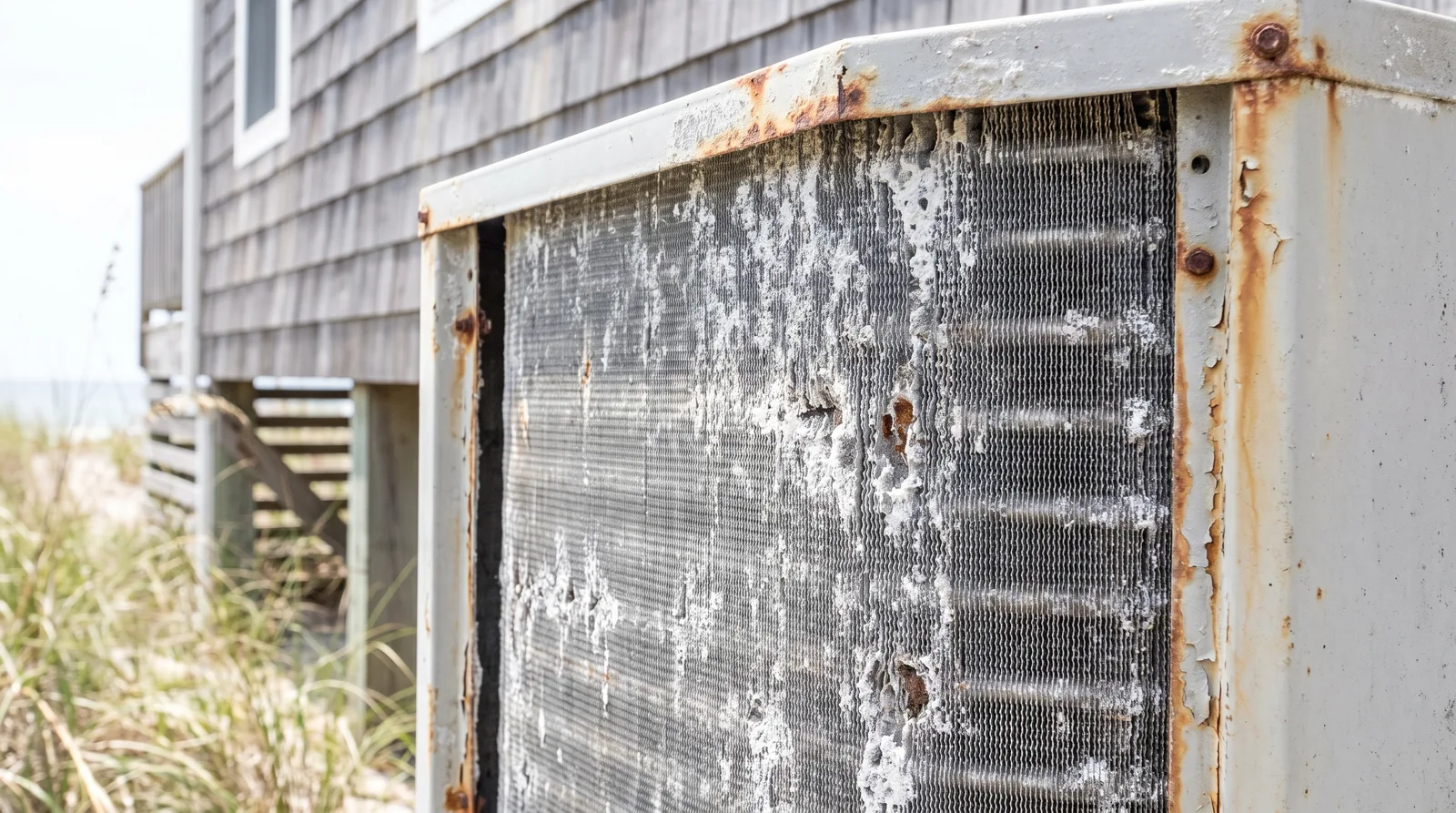
- White powdery bloom on the fins. A chalky, crusty deposit sitting on the aluminum. That is corrosion product, and it means the process is well underway.
- Chalky, faded paint on the cabinet. Paint that comes off on your hand as a dusty residue has lost its protection. Rust follows.
- Rust streaks at seams, screws and the base. Look at the bottom corners and along panel joints, where water sits longest.
- Fins that crumble. Press very gently with a fingertip in one spot. Healthy fins bend. Badly corroded fins break apart. If they crumble, heat transfer is already compromised.
- Oily residue or a hissing sound. Refrigerant leaks often leave an oily film. That one is a phone call, not a project.
What you can safely do yourself
Rinse the coil with fresh water
This is the single most effective thing a coastal homeowner can do. The goal is simply to wash the salt off before it sits there holding moisture against the metal.
Turn the power off first. Switch the system off at the thermostat, then turn off the outdoor disconnect or the breaker. Then rinse the outside of the coil with a regular garden hose, gentle pressure, working top to bottom, all the way around the unit. Let it dry, restore power, and you are done.
How often depends on where you are. On the barrier islands, monthly through the cooling season is reasonable, and after any storm that blows spray inland. On creek-front and near-marsh properties, every couple of months is plenty.
What not to do
Do not use a pressure washer. Condenser fins are thinner than a business card and a pressure washer flattens them instantly. Bent-over fins block airflow, which does more damage to your cooling than the salt was doing.
Do not use household cleaners, degreasers or bleach. Some are acidic or alkaline enough to attack aluminum directly. Plain water is what you want. Proper coil cleaners exist, but they belong to whoever is doing your annual maintenance.
And draw a firm line at the panels. Rinsing the outside of a coil is homeowner work. Removing a service panel, pulling the top and fan assembly, touching the disconnect internals or doing anything with the electrical compartment is technician work, because there are capacitors in there that hold a charge even with the power off.
Keep the salt and the shrubs off it
Give the unit two feet of clear air on all sides. Overgrown shrubs and lattice screens trap humid air against the cabinet and keep it damp, which is the exact condition corrosion needs.
Sensible placement matters too. If you are replacing a system or building, putting the condenser on the leeward side of the house rather than the side facing the prevailing salt-laden wind is a real advantage that costs nothing. A wall, a garage or the house itself between the ocean and the unit takes a meaningful bite out of the salt load.
Coatings and coastal equipment, honestly
Factory-applied coil coatings are worth having near the water. They put a barrier between the salt film and the metal, and they change the shape of the problem — but they slow corrosion, they do not stop it. Nobody should sell you a coating as a permanent fix.
Manufacturers also make coastal or seacoast-rated equipment with heavier-gauge cabinets, corrosion-resistant hardware and treated coils from the factory. On the islands, that is usually the right call at replacement time. Worth knowing: ductless mini-splits have outdoor units subject to exactly the same exposure, so the same rinsing and coating logic applies to them.
The other honest point is that corrosion is not usually what you notice first. Reduced cooling, longer run times and higher bills show up well before a coil actually leaks, which is why a coastal system benefits from being looked at more often than an inland one. That is a good part of what our maintenance plan is for near the water — catching fin degradation and cabinet rot while they are still just observations rather than repairs.
Not sure how bad yours is?
If you have looked at your unit and cannot tell whether that is normal weathering or something worse, we will tell you straight. We check for fin corrosion and cabinet rust on every visit, and we will say whether you are looking at years of life left, a coil approaching the end, or something in between.
Call or text 843-609-5740 — answered any hour, any day — or request a visit online. Estimates on replacement are free and in your home, and our technicians earn no commission on equipment, so nobody gains anything by telling you the salt air got it when it did not.