


There is a point where patching ductwork stops being a good use of money. When a duct system is undersized, badly laid out, crushed in several places or has spent years wet under a house, sealing the joints only buys you a little. Replacement fixes the thing that was actually wrong.
We do not lead with this recommendation. Most of the crawlspaces we look at in the Lowcountry need repair and sealing, not replacement, and we will tell you when that is the case. But when a system was never designed properly, redesigning it is what finally makes the house comfortable.
When repair stops making sense
- Too many failures to count. When a majority of the joints are open and the flex is deteriorating along its length, you are sealing a system that is coming apart everywhere.
- Wet insulation and torn vapor barrier throughout. Common under older homes in West Ashley, James Island and downtown Charleston, and worse after a crawlspace floods during hurricane season. Insulation that has been soaked repeatedly does not recover.
- Undersized trunk or branches. No amount of sealing adds capacity to a duct that is too small. If static pressure is high with everything sealed, the duct itself is the restriction.
- Rooms that have never been comfortable. A room fed by a long, skinny branch off the far end of the trunk was doomed at installation. It needs a different run, not tape.
- New equipment going in. A modern variable-speed system moves air differently than what it replaces. Putting it on 1970s ductwork wastes most of what you paid for. If you are planning a new system, this is the moment to fix the delivery side.
Replacement is a redesign, not a swap
The mistake is replacing bad ductwork with the same layout in new material. If the design was wrong, you have just bought the same problem in clean plastic.
We start with load and airflow, not with what is already there. That means calculating what each room actually requires based on its size, exposure, window area and how it is used, then sizing trunk and branches to deliver it. In a Charleston home, west-facing rooms and second floors need more than a rule of thumb gives them.
We also design for the equipment. The duct system has to be able to move the airflow the blower is rated for at a static pressure it can work against. Get that wrong and you have a system that short-cycles — which in this climate means it never runs long enough to pull humidity out, and the house stays cool but clammy. Long, steady run times are what make a Lowcountry house feel dry.
Returns: the part almost every older home gets wrong
Most of the duct problems we find in older Charleston homes are on the return side, not the supply. A single undersized central return in a hallway was standard practice for decades, and it does not work.
Air that goes into a room has to get back out. Close a bedroom door with one central return and that room pressurizes, airflow into it drops, and the rest of the house goes slightly negative — which pulls outside air in through every gap in the building. In a humid climate, that is humid air. Homeowners experience it as one bedroom that is always warm and a house that feels sticky in the afternoon.
Fixing it means adding returns, transfer grilles or jump ducts so each room can breathe. It is one of the least glamorous parts of a duct replacement and one of the most noticeable afterward.
What the job involves
- Assessment and design. Room-by-room load, static pressure readings, register airflow, and a full inspection of the crawlspace or attic. We show you photographs of what is there now.
- A written itemized quote. Before anything is ordered, you see the scope, the materials and the price in writing. What drives cost is the amount of duct, crawlspace access and clearance, how much redesign is needed and whether returns are being added.
- Removal. Old duct, damaged insulation and failed vapor barrier come out and leave with us.
- Installation. Correctly sized trunk and branches, properly supported at the right intervals, gentle radius bends, mechanically fastened and mastic-sealed at every joint. Insulation rated for our climate with a continuous, sealed vapor barrier — in a vented crawlspace that barrier is what stops the duct sweating in August.
- Registers, boots and returns. Boots sealed to the floor or ceiling, new returns cut in where the design calls for them.
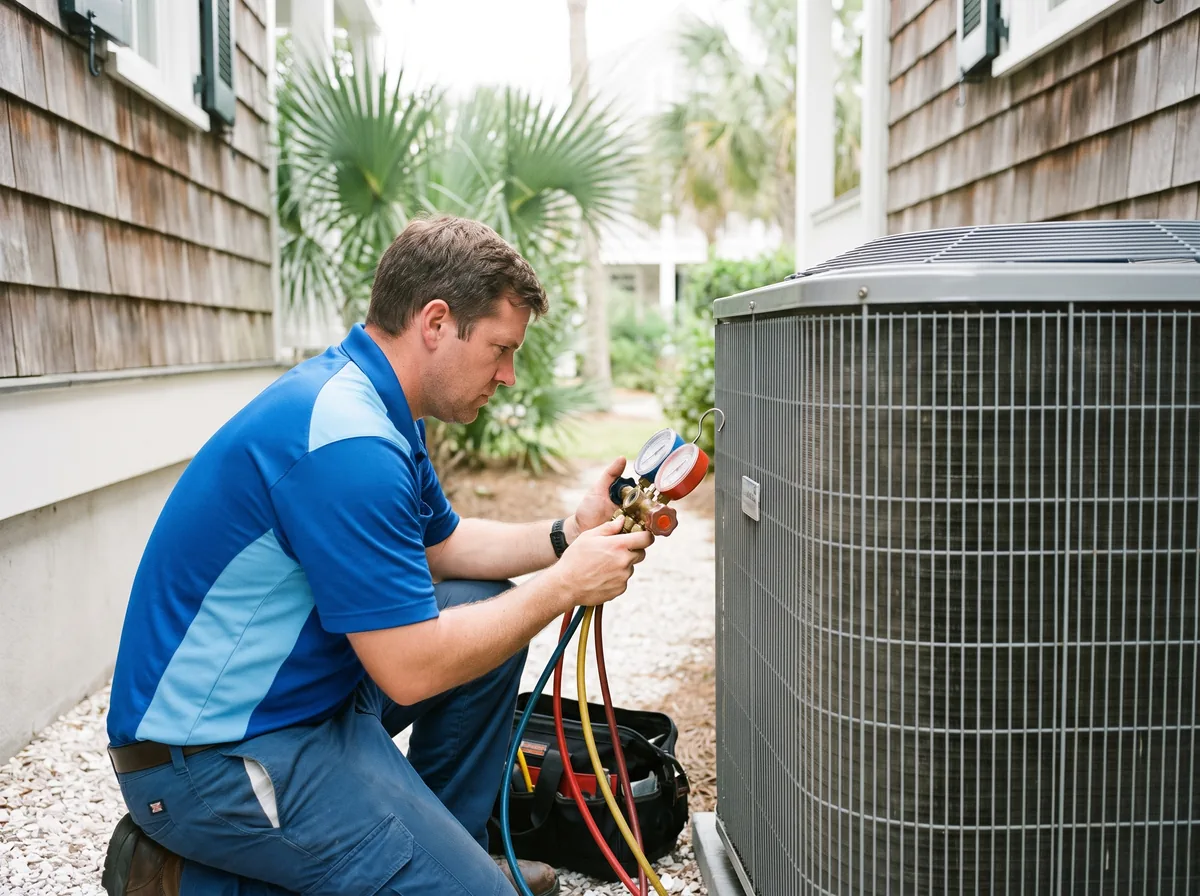
- Testing and balancing. We measure static pressure and airflow at each register, then adjust until the numbers match the design. You get the readings.
Homes with no ductwork, or nowhere to put it
Plenty of historic homes downtown and on the peninsula have no duct system at all, or one that was retrofitted into whatever cavity was available and has been undersized ever since. In those houses, forcing in a conventional duct system is sometimes not the right answer.
Ductless mini splits handle those situations well, zone by zone, without tearing into plaster and original trim. We will tell you when that is the better path for your house.
What you get out of it
Rooms that hold the temperature the thermostat says. Longer, quieter run cycles that actually remove moisture. Less dust, because the return has stopped pulling from the crawlspace. And equipment that is no longer working against restriction it was never designed for — which is what makes routine maintenance worth something.
Our technicians earn no commission on equipment, estimates on replacement are free and in-home, and financing is available subject to approved credit.
If your ducts have been patched more than once, let us measure the system and give you the real picture. Call or text 843-609-5740 any time, or request an estimate online.
Cleaning the ducts is a separate job from repairing them. If the ducts are sound but the air is not, see air duct cleaning under indoor air quality.