


Most homes in the Greater Charleston area heat with a heat pump. Most homeowners here call that machine a furnace. The confusion is completely understandable, and it matters for one practical reason: a heat pump fails in ways a furnace never does, and knowing which one you own tells you a lot about what is actually wrong.
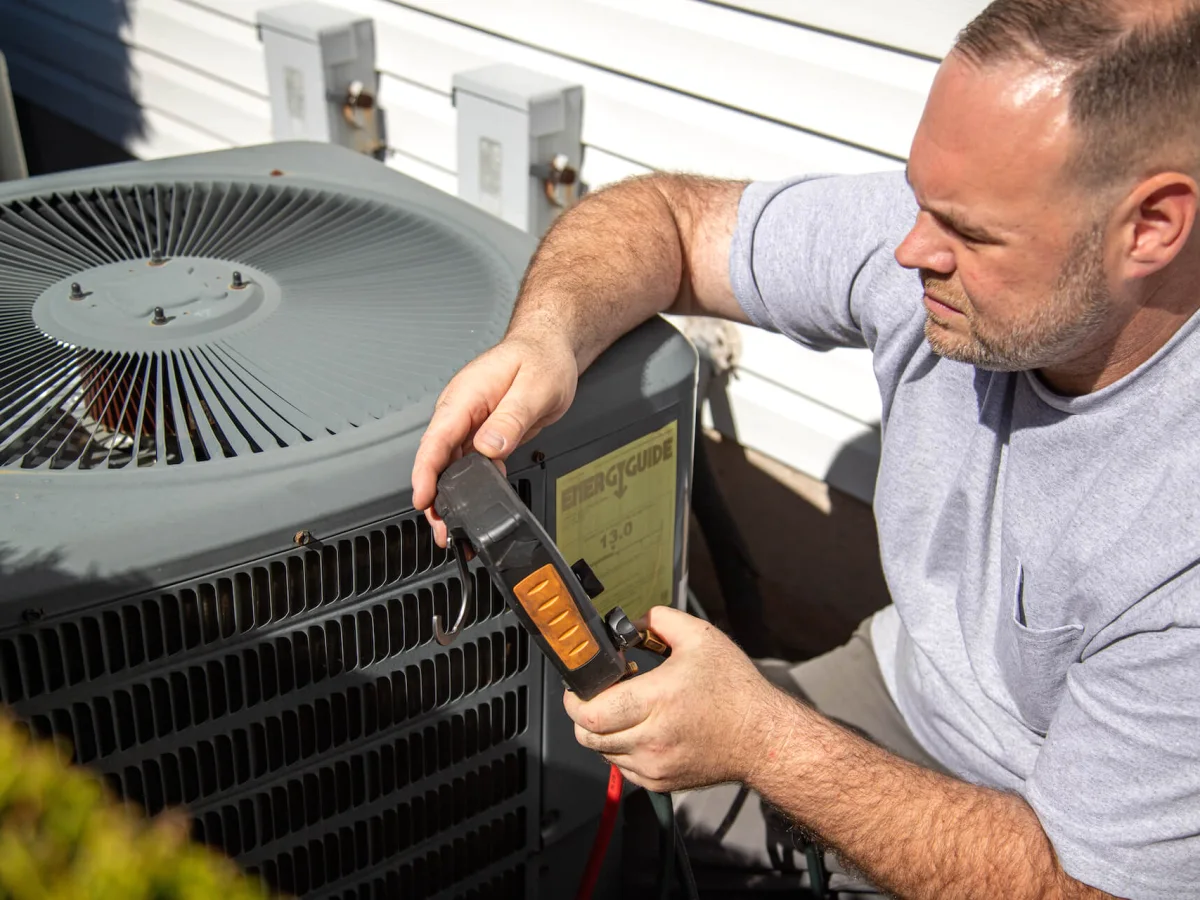
If your outdoor unit runs in the winter, you have a heat pump. It is the same box that cools you in July, running in reverse. That also means a heat pump problem is a year-round problem — one machine, two seasons, twice the run hours.
Symptoms that point to a heat pump fault
- The air from the vents feels lukewarm in winter. This is often normal. Heat pump supply air runs cooler than furnace air, around body temperature, so it can feel weak on your hand while still heating the house perfectly well.
- The outdoor unit is running but the house is not warming. Frequently a stuck reversing valve, low refrigerant charge, or a control board fault.
- The system heats when it should cool, or the reverse. Classic reversing valve or thermostat wiring problem.
- The power bill jumps in January without a cold snap to explain it. Almost always auxiliary heat running when it should not be.
- The outdoor unit is buried in ice. See below — some frost is normal, a solid block is not.
- Loud buzzing, a hard hum, or a breaker that keeps tripping. Stop resetting it and call. That is an electrical fault.
Ice on the outdoor unit: when to worry
A heat pump pulling heat out of 38°F air with 90% humidity will frost over. That is physics, not a fault. The system is designed for it and runs a defrost cycle every so often — it briefly switches to cooling mode, the outdoor coil warms, steam rolls off it, and it goes back to heating. Seeing that once or twice on a damp January morning is a healthy system doing its job.
What is not normal is ice that never clears. If the coil is encased in a solid sheet, if ice is building on top of the cabinet or around the fan, or if the unit has looked like that for days, the defrost cycle is not working. The usual culprits are a failed defrost control board, a bad defrost thermostat or sensor, a stuck reversing valve, or low refrigerant. Left alone, running a heat pump in that state damages the compressor. Shut it off at the thermostat, switch to emergency heat, and call us.
Auxiliary heat, and why your bill spiked
Every heat pump in the Lowcountry has electric resistance heat strips as backup. They are meant to run for short stretches on genuinely cold mornings, or briefly during a defrost cycle. They use several times the electricity the heat pump does.
When people call in January convinced the system has broken because the bill doubled, the system usually has not broken at all — the strips have simply been running most of the time. Common causes we find:
- A misconfigured thermostat. A replacement thermostat wired or set up wrong will call for auxiliary heat far more aggressively than it should. Big setbacks overnight cause it too, because the recovery triggers the strips. A properly configured smart thermostat avoids most of this.
- Someone left it in emergency heat. That switch bypasses the heat pump entirely and heats the house with strips alone. It happens more often than you would think.
- Low refrigerant charge. The heat pump cannot keep up, so the strips fill the gap continuously and quietly.
- A failed defrost board or outdoor unit. The strips are doing all the work because nothing else is.
All four look identical on a power bill and completely different on a meter. We diagnose before we quote.
What actually fails on these systems
After eight-month cooling seasons plus winter heating, Lowcountry heat pumps accumulate serious run hours, and a handful of parts do most of the failing. Capacitors weaken with heat and age and are the single most common repair. Contactors pit and burn from constant cycling. Defrost control boards fail and take winter performance with them. Reversing valves stick or leak internally. Refrigerant leaks develop at the service valves, the line set, or a corroded coil. Blower and condenser fan motors wear out.
Our technicians carry the parts that fail most often on these systems, so the majority of repairs are done on the first visit. You get a firm price before any work starts and photographs of the actual failed part.
Salt air shortens the odds
If you live on Isle of Palms, Sullivan’s Island, Folly Beach or anywhere within a few miles of the water, salt corrodes the coil fins, the cabinet and the electrical contacts inside it. Coastal heat pumps fail earlier and fail differently — we check for corrosion and contact damage on every visit, and rinsing the coil with fresh water between services genuinely helps.
Repair or replace
If the system is under roughly ten years old and the repair is a fraction of replacement, repair it. If it has failed more than once in a season, still runs R-22, or needs a compressor or coil, the numbers usually favor replacement. We give you both figures and let you decide. Our technicians are not paid commission on equipment.
Regular heating maintenance catches most of these faults in the fall, before you need the system. If yours has already quit, call or text 843-609-5740 or reach us here.